Nightfall
AI Data Leak Prevention Tool
Prevent data leaks with Nightfall AI, the fastest, easiest, and most accurate AI data leak prevention tool.
- Pricing
- Paid
- Category
- AI Detector
- Listed
- Jul 22, 2023
- Updated
- May 25, 2026
Promoted
 KurodyneSell the tools from your AI side projects. Listing is free.
 Sidrune AI85% off. Stable Claude API for agent developers. Pay as you go. Invoices & refunds available.
 Pixmax.aiPixmax.ai is an all-in-one AI workspace for videos, visual stories, and marketing content.
 SEOify - Improve your SEO & rankingsBuild links to rank in Google. Improve your DR with links you can start building now.Advertise here270,000+ people visit Dang.ai every month.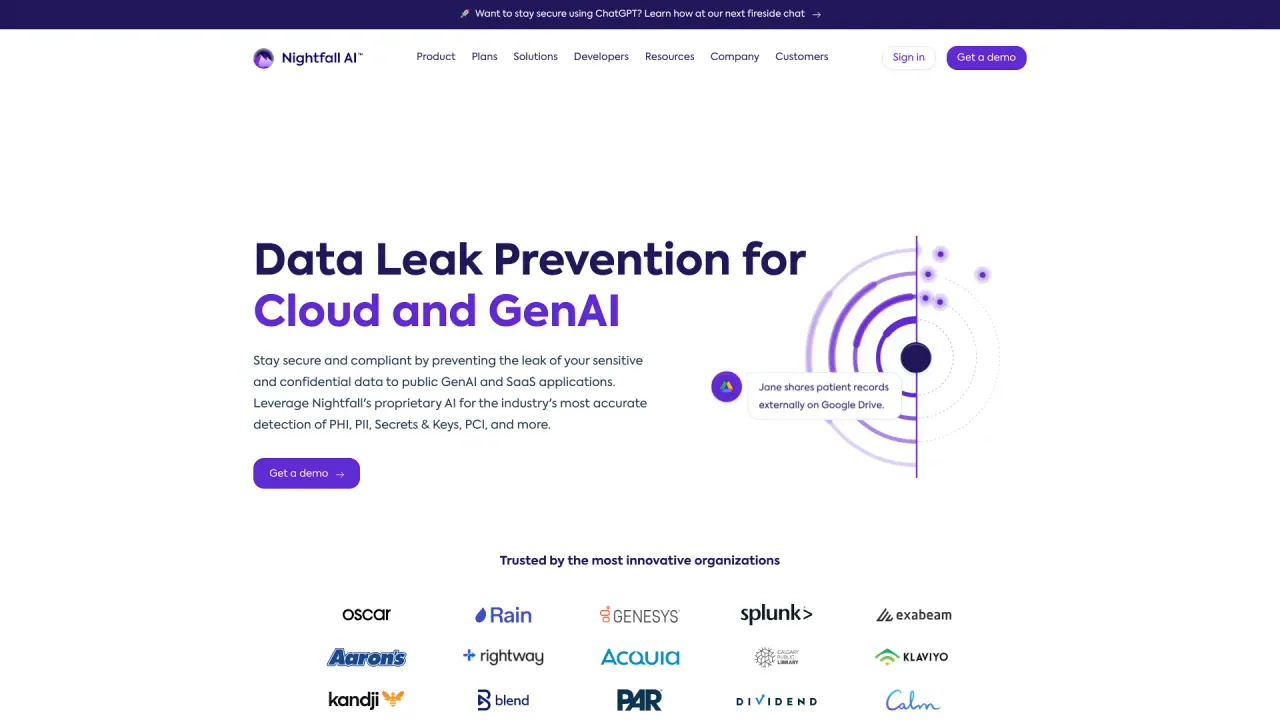
What does Nightfall do?
What is Nightfall and what problems does it solve?
Nightfall is an AI-native data loss prevention (DLP) platform that prevents sensitive data exposure and exfiltration across SaaS, endpoints, email, browsers, and AI apps. It uses 100+ AI-based models, including LLM-based file classifiers and Computer Vision models, to classify content with high accuracy and automatically track data lineage from source to destination. Nightfall provides API-based SaaS integrations, lightweight endpoint agents, and browser plugins to deploy quickly and continuously improve detection, reducing alert fatigue and enabling autonomous protection.
How does Nightfall stop data leakage and protect sensitive data (NHIs, PHI, PCI, PII)?
Nightfall combines AI-powered content classification with intelligent data lineage to monitor data movement and identify sensitive information such as non-human identities (NHIs), PHI, PCI, and PII across apps like Slack, Google Workspace, Salesforce, Jira, and more. It uses LLM-powered file classifiers to identify data by structure and meaning, not just keywords. When risky behavior is detected, Nightfall can block exfiltration, redact data in apps, revoke inappropriate permissions, or quarantine, delete, or encrypt data while keeping business workflows visible and intact.
Who is Nyx, and what does the Nyx autonomous DLP analyst do?
Nyx is Nightfall’s autonomous DLP analyst. It brings investigative judgment, business context, and intervention capabilities to security operations, enabling 24/7 automated investigation of sensitive data exposure and exfiltration. Nyx guides responses and helps shape user behavior to prevent data from getting exposed.
How does Nightfall secure AI tool usage and protect against Shadow AI?
Nightfall provides Shadow AI security across generative AI apps (including prompts to tools like ChatGPT, Copilot, Gemini, Claude, and others). Browser plugins and endpoint agents monitor AI interactions in real-time, intercepting sensitive data before it reaches AI platforms. Nightfall blocks secrets, credentials, PHI, PCI, PII, or other confidential information in prompts, uploads, or clipboard actions, and maintains visibility through data lineage even when information is copied, pasted, or transformed.
How quickly can Nightfall be deployed, and what does the implementation timeline look like?
Nightfall is designed for rapid deployment with minimal disruption. SaaS integrations can be completed in under one hour via API connections, and endpoint deployment via MDM reaches full coverage within about a week. The first data scan often reveals hundreds to thousands of previously unknown violations within 24 hours, and most customers achieve comprehensive protection across SaaS, endpoints, and AI tools in under a month.
What platforms and apps does Nightfall integrate with?
Nightfall offers broad integrations across:
- SaaS apps and endpoints: Slack, Google Drive, Gmail, Jira, Confluence, Salesforce, Microsoft Teams, Microsoft OneDrive, Microsoft Exchange Online, Microsoft SharePoint Online, Notion, Zendesk
- Endpoints & Browsers
- AI Apps
These integrations enable unified policy enforcement and visibility without heavy network changes.
Can Nightfall replace existing DLP and insider risk tools?
Yes. Nightfall can consolidate legacy point solutions into a single AI-powered platform, delivering complete visibility across SaaS, endpoints, email, browsers, and AI apps. This unified approach reduces vendor sprawl, lowers total cost of ownership, and speeds investigations, with out-of-the-box accuracy around 95%.
What insider risk scenarios can Nightfall detect?
Nightfall detects a range of insider risks, including malicious insiders, opportunistic insiders, and negligent insiders. It identifies unusual download patterns, unauthorized data movement to personal devices or domains, suspicious exfiltration over days or weeks, and multi-channel exfiltration. Data lineage and risk scoring help distinguish routine activity from genuine threats, reducing false positives while catching real risks.
What makes Nightfall different from traditional DLP solutions?
Nightfall combines AI-driven content understanding with data lineage to deliver context-rich risk insights. Key differentiators include:
- AI + Context: Deep understanding of sensitivity and complete data journey
- Holistic Coverage: End-to-end protection across SaaS, AI apps, endpoints, and browsers
- Frictionless Deployment & Maintenance: Quick API integrations, lightweight agents, and self-learning policies
- Streamlined SecOps: Intuitive exposure and intent views to speed investigations
- Human Firewall: End-user coaching and self-remediation to reduce SOC burden
How does Nightfall support compliance across industries?
Nightfall helps organizations meet regulatory requirements by precisely identifying PII, PCI, and PHI and enforcing data protection across critical domains. It supports industries such as Technology, Healthcare, Financial Services, Legal, and Manufacturing, and aligns with frameworks like HIPAA, PCI, GDPR/CCPA, ISO 27001, SOC 2, and SOX through accurate data detection and governance capabilities.
What kind of value and ROI can customers expect after implementing Nightfall?
Value starts immediately:
- Quick time to value: SaaS integrations in under an hour; initial scans reveal violations within 24 hours
- Broad coverage within weeks: Endpoint and app coverage scales rapidly
- High accuracy and automation: 95% out-of-the-box accuracy with ongoing improvements; up to 80% automated remediation
- ROI: Customers commonly see significant efficiency gains and faster investigations, with stronger protection across their data environment
How does Nightfall integrate with other security tooling, SIEM/SOAR, and identity providers?
Nightfall integrates with existing security ecosystems through flexible alerting and SIEM/SOAR connectivity. It can push violations to Slack, Microsoft Teams, Jira, or email, and supports identity provider integrations with Okta, Entra ID, and Google Directory for synchronized policies. It also works with MDM solutions for endpoint deployment and provides audit logs for SIEM integration, ensuring threat intelligence flows into security workflows.
Is this your tool?
Claim Nightfall to manage this listing, or upgrade to Pro for featured-first placement and a newsletter feature.