
BitoAI
Verified
AI Virtual Assistant
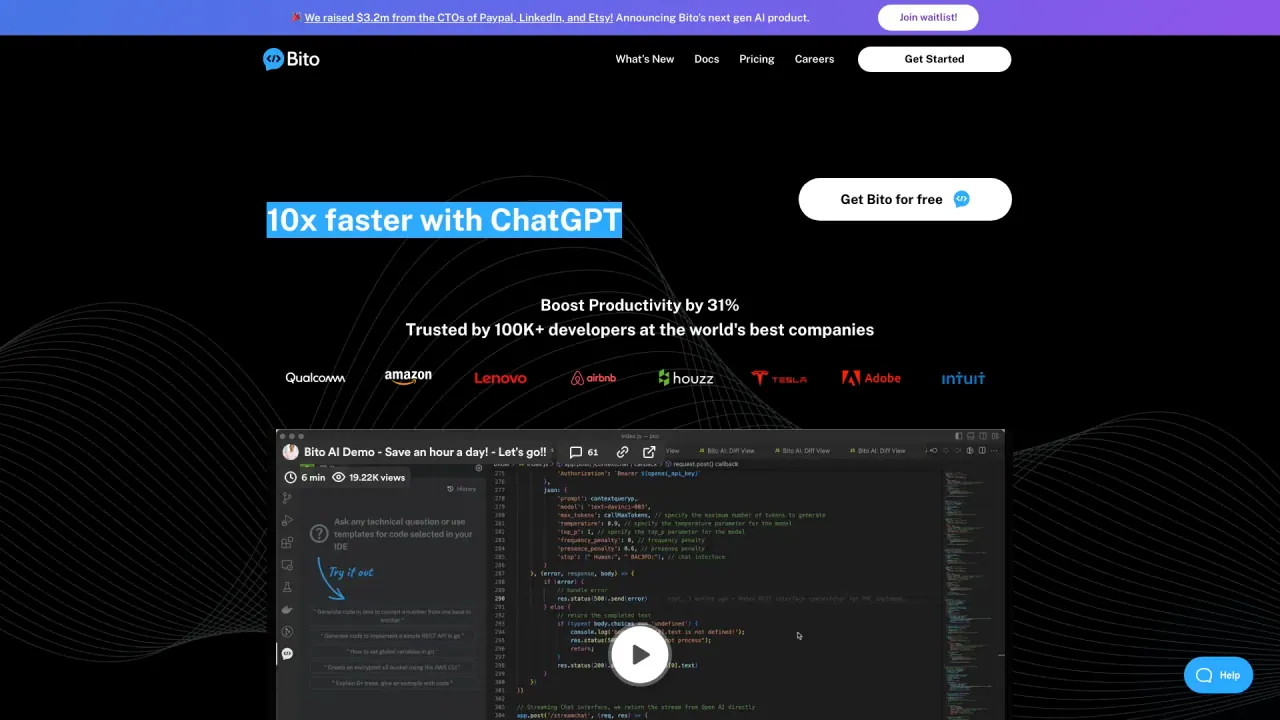
Generate amazing code effortlessly with BitoAI, the trusted AI virtual assistant for developers. Boost your productivity by 31%!
Promoted


What does BitoAI do?
What is the context layer for engineering?
A context layer is a live, structured understanding of your entire engineering system, including how your repositories, services, APIs, and dependencies connect and interact. Without it, AI coding agents work on isolated files with no understanding of system-level impact. With it, every technical decision—from feasibility analysis to code generation to code review—is grounded in how your system actually works.
What is Bito’s AI Architect?
Architect-level intelligence for every engineer. AI Architect builds a knowledge graph of your codebase and operational history, mapping services, dependencies, and APIs across every repository. It then runs feasibility analysis, technical design, and cross-repo impact assessment your team would otherwise spend days on. Outputs include:
- Feasibility report with gaps, risks, and a recommended approach
- Technical design document with implementation approaches, effort estimates, and flagged landmines
- Cross-repo impact map showing affected services, APIs, and risks
- Epic breakdowns into Jira-ready stories with contextual guidance
How are Bito’s AI code reviews different from other AI code review tools?
AI Architect brings the same codebase context and operational history to every phase of development. Pre-coding, coding, and code review all draw from the same knowledge graph, ensuring decisions are grounded in your actual system. It reads each spec against your live codebase to flag what’s buildable, what needs rethinking, and what risks exist, and it provides outputs like feasibility reports, technical designs, impact maps, and Jira-ready story breakdowns.
How does Bito index large or multi-repo codebases?
Bito goes behind traditional embeddings to index your entire system as a dynamic knowledge graph. From repos to modules to APIs and libraries, Bito deeply understands context and intent—the how and why something is implemented in your codebase.
How does Bito handle security, privacy, and deployment?
- No code storage or model training: your code stays yours; Bito does not store your code. Metadata (like file names and line numbers) may be stored, and all messages and metadata are encrypted in transit and at rest.
- End-to-end encryption and flexible deployment: runs on-premises or in the cloud.
- Enterprise security: SOC 2 Type II certified.
- Optional encryption-key control: you can provide your own encryption keys for additional security.
- You can contact support for more options and details.
What are the main benefits of using Bito for development teams?
- Save significant time: teams have reported saving 30% to 35% of human hours spent in code review each week.
- Real-time AI feedback within your IDE or Git provider, enabling faster shipping.
- Junior engineers can up-skill through precise, educational suggestions.
- Reduce code regressions by focusing on security, scalability, performance, and code understanding.
How can Bito help junior engineers improve their coding skills?
Bito delivers precise suggestions with educational context, highlighting best practices and focusing on security, scalability, performance, and understanding. By integrating seamlessly into your development workflow, junior engineers learn more effectively and grow into higher performers.
How do I get started with Bito?
- Download the extension from this page or your IDE marketplace.
- If you’re the first user for your organization, Bito will ask you to create a workspace. You can set it so that everyone with the same domain can automatically join, or you can add teammates to collaborate.
- Check the guide for detailed setup instructions (Installing Bito Extension).
- If you have questions, join the user group on Slack or email support@bito.ai.
How much does Bito cost?
Bito is currently in alpha and is free to use.
This listing is claimed
Own BitoAI? Sign in with the email used to claim it to manage this listing, or upgrade to Pro for featured-first placement and a newsletter feature.