
Rodin Diffusion
AI Avatar Generator
Effortlessly create intricate 3D avatars with RODIN Diffusion, the innovative AI avatar generator.
What does Rodin Diffusion do?
What is Rodin Diffusion and what can it do?
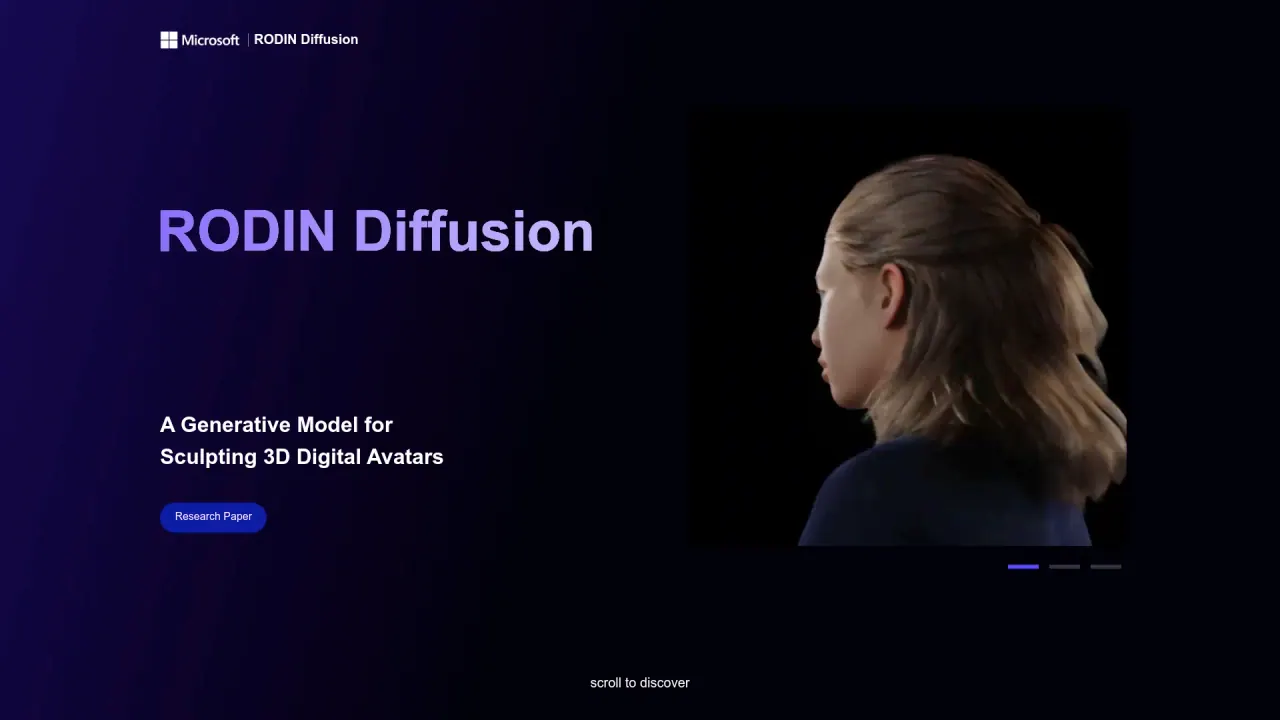
Rodin Diffusion is a 3D avatar diffusion model that automatically creates highly detailed 3D digital avatars. The generated avatars can be freely viewed in 360 degrees with high quality, accelerating the traditional 3D modeling process and enabling new opportunities for 3D artists.
What representations and rendering techniques does Rodin Diffusion use for 3D avatars?
Rodin Diffusion models 3D avatars as neural radiance fields and uses a tri-plane representation to factorize the radiance field. It employs 3D-aware convolution for computational efficiency, and rendering to images is done via volumetric rendering. The generation is a hierarchical process with cascaded diffusion models for multi-scale modeling.
How can I guide avatar creation (portrait-based or text-based)?
You can guide avatar creation in two ways:
- Portrait-guided: create a high-fidelity personalized 3D avatar from a portrait.
- Text-guided: build an elaborate 3D avatar from scratch using natural language prompts.
The system supports controlling generation via a latent code derived from an input image, a text prompt, or random noise.
Can I edit a generated avatar after creation?
Yes. Rodin Diffusion supports text-guided editing to modify a wide range of attributes, including:
- Appearance: hairstyle and facial hair (e.g., blonde hair, short hair, braids, beards)
- Accessories and outfits (e.g., glasses, pink suit, white suit)
- Facial expressions (e.g., smiling)
- Diversity (acknowledging varied genders, ages, ethnicities, etc.)
Can I view avatars in 360 degrees?
Yes. Generated avatars can be freely viewed in 360 degrees with high quality.
What inputs does Rodin Diffusion accept to guide generation?
Generation can be guided by:
- An input image (portrait or other reference)
- A text prompt
- Random noise (latent code)
These inputs enable portrait-guided creation, text-guided creation, or random-generation-based outputs.
How does Rodin Diffusion address responsible AI and misuse?
The model acknowledges the potential for misuse of AI-generated content. To mitigate risks, it is recommended to incorporate tags or watermarks when distributing generated photos to help ensure responsible use and deter misuse.
Where can I learn more about Rodin Diffusion (the research paper)?
For more details, see Rodin: A Generative Model for Sculpting 3D Digital Avatars Using Diffusion, arXiv preprint, 2022. The paper lists the contributing authors and affiliations.
How diverse are the avatars Rodin Diffusion can generate?
Rodin Diffusion demonstrates impressive generation diversity across gender, age, ethnicity, expressions, face accessories, and other attributes.
Is this your tool?
Claim Rodin Diffusion to manage this listing, or upgrade to Pro for featured-first placement and a newsletter feature.