
Beach Does Not Exist
AI Beach Image Generator
Generate lifelike beach images with This Beach Does Not Exist - StyleGan - a powerful AI tool.
- Listed
- Aug 4, 2023
- Updated
- May 25, 2026
Promoted
 Pixmax.aiPixmax.ai is an all-in-one AI workspace for videos, visual stories, and marketing content.
 AI Checker PlusAI detector that highlights which passages AI wrote. Free check, no sign-up. Plagiarism too.
 RewindType any X/Twitter handle. Get their year back as a narrated video story. Then ask it anything.
 KurodyneSell the tools from your AI side projects. Listing is free.
 Sidrune AI85% off. Stable Claude API for agent developers. Pay as you go. Invoices & refunds available.
 SEOify - Improve your SEO & rankingsBuild links to rank in Google. Improve your DR with links you can start building now.Advertise here270,000+ people visit Dang.ai every month.
What does Beach Does Not Exist do?
Are the beaches generated by this tool real or AI-generated?
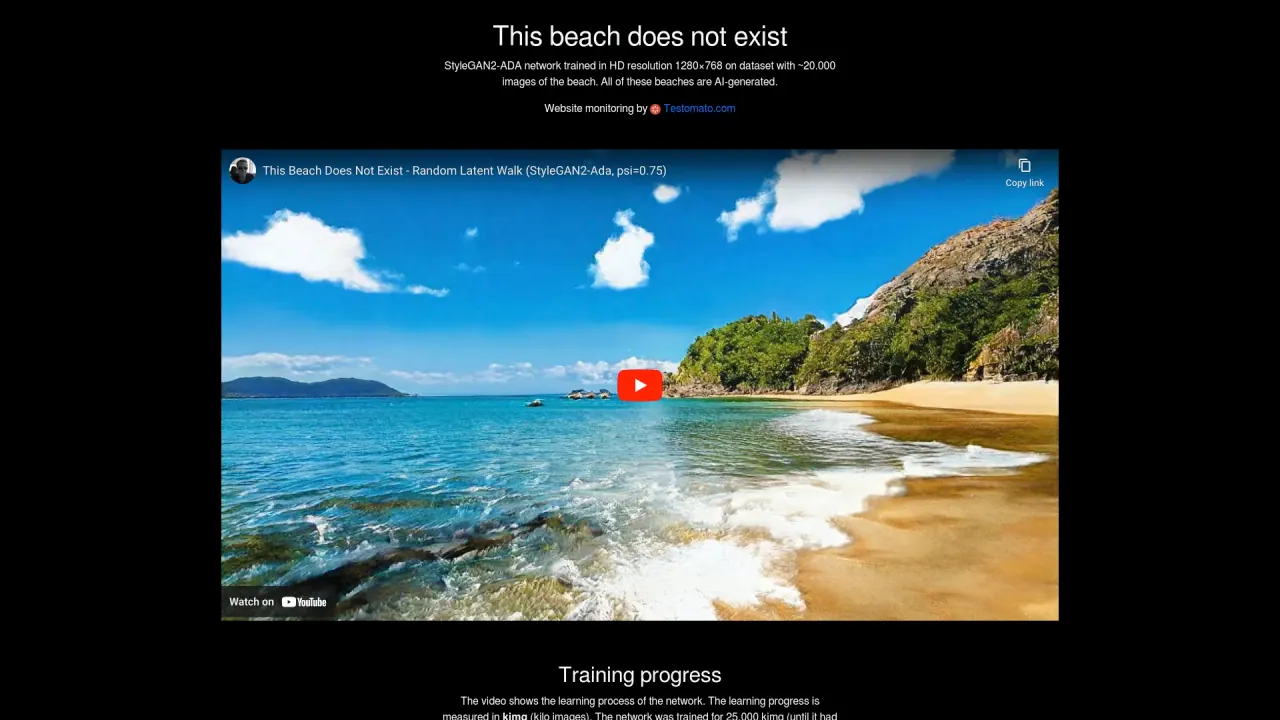
All beaches are AI-generated. The tool uses a StyleGAN2-ADA network trained on a dataset of beach images to create synthetic beach visuals at 1280×768 pixels.
How are AI-generated beach images created on this tool?
The tool employs a StyleGAN2-ADA network trained on approximately 20,000 beach images. Images are generated at a resolution of 1280×768 pixels, and all beaches produced are synthetic.
Can I download the model/network or use it for transfer learning?
Yes. You can download the network package (362 MB) for your experiments or retrain the network with your own dataset via transfer learning.
What are the key technical details of the model?
- Architecture: StyleGAN2-Ada
- Dataset: ~20,000 beach images
- Network size: 362 MB
- Resolution: 1280×768 px
- Network layout: 5×3 squares (with 28 = 256 px sides)
- Training options: --min_w=5 --min_h=3 --res\_log2=8
- Training steps: 25,000 kimg
- FID50k: 3.14
- Original framework: StyleGAN2-ADA (NVIDIA research lineage)
- Author: Vojtěch Semecký
- Contact: info@thisbeachdoesnotexist.com
How is training progress tracked and what does 25,000 kimg mean?
Training progress is shown as kimg (kilo images). The network was trained for 25,000 kimg, which corresponds to about 25,000,000 images seen during training.
What is the FID score for this model?
The model reports an FID50k score of 3.14.
What is K-Means Clustering used for in this tool?
K-Means clustering groups similar AI-generated beach images to help users explore variations, segment images into clusters based on similarities, and identify common features among random images.
Who maintains the site and how is it monitored?
The site is monitored by Testomato.com.
Is this your tool?
Claim Beach Does Not Exist to manage this listing, or upgrade to Pro for featured-first placement and a newsletter feature.