
ArtReviewGenerator
AI Art Review Writer
AI Art Review Writer: Generate insightful art reviews with this powerful AI tool. Analyze and describe fine art with natural language processing.
Promoted
 KurodyneSell the tools from your AI side projects. Listing is free.
 Sidrune AI85% off. Stable Claude API for agent developers. Pay as you go. Invoices & refunds available.
 Pixmax.aiPixmax.ai is an all-in-one AI workspace for videos, visual stories, and marketing content.
 RewindType any X/Twitter handle. Get their year back as a narrated video story. Then ask it anything.
 SEOify - Improve your SEO & rankingsBuild links to rank in Google. Improve your DR with links you can start building now.Advertise here270,000+ people visit Dang.ai every month.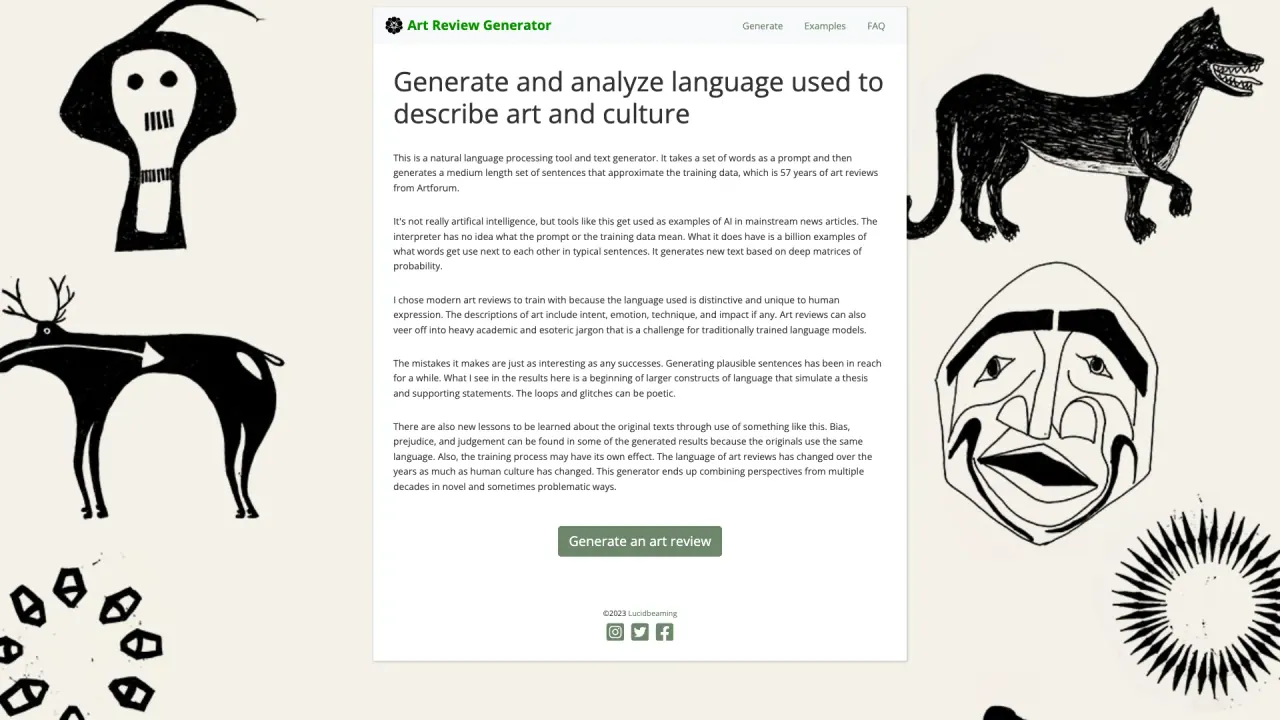
What does ArtReviewGenerator do?
What is the Art Review Generator and how does it work?
The Art Review Generator is described as a natural language processing tool and text generator. It is trained on 57 years of art reviews from Artforum and takes a user-provided set of words as a prompt to generate a medium-length set of sentences that approximate the training data. It uses probability-based word predictions to produce text that mimics the distinctive language and style of art reviews, and it’s noted that it is not really artificial intelligence.
What data was the generator trained on?
The model is trained on 57 years of Artforum art reviews. This training captures the language, biases, and cultural nuances found in those reviews, and it reflects how art-language has changed across decades. The generator may combine perspectives from multiple decades in novel and sometimes problematic ways.
What kind of output should I expect?
You can expect a medium-length sequence of sentences generated from a prompt consisting of words you provide. The output aims to resemble the language of art reviews and can include a thesis-like structure with supporting statements. It may also include loops or glitches that some users experience as poetic.
Can it generate academic or poetic language?
Yes. The generator can produce both academic and poetic language, reflecting the distinctive style of modern art reviews with esoteric jargon. It may also produce loops or glitches that readers interpret as poetic.
Does the model reveal biases or cultural elements?
Yes. The generator can reflect biases, prejudices, and cultural elements present in the training data. Because the underlying texts contain those elements, generated results may also reveal them, which users should critically consider.
Is Art Review Generator AI?
The tool is described as not really artificial intelligence, but a natural language processing tool and text generator trained on a large corpus of art reviews.
How should prompts influence the results?
You provide a set of words as a prompt, and the tool generates text that approximates the training data. The language and perspectives may draw from multiple decades, reflecting the evolving nature of art criticism, and prompts can steer the direction of the output toward different stylistic or topical emphases.
What are the limitations or caveats?
The generator can reflect biases and limitations of its training data, may not fully capture the nuances of visual art, and can blend perspectives from different decades in ways that are not always appropriate. Users should apply critical judgment when interpreting the outputs.
Is this your tool?
Claim ArtReviewGenerator to manage this listing, or upgrade to Pro for featured-first placement and a newsletter feature.