
Cyanite
AI Music Categorization Service
AI music categorization service for advanced music search and tagging.
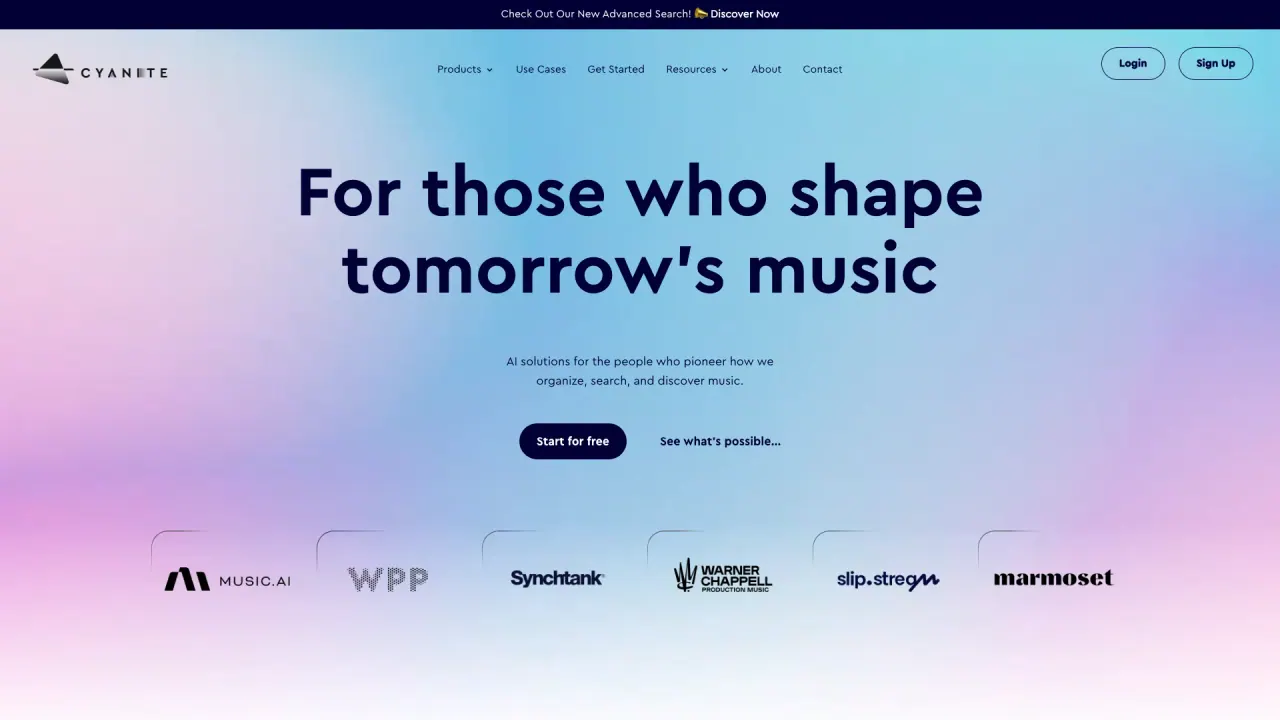
What does Cyanite do?
What does Cyanite do?
Cyanite provides AI-powered music tagging and search tools to help you organize, search, and discover your music catalogs. Core capabilities include Auto-Tagging & Descriptions, Similarity & Free Text Search, a New Advanced Search, and a Music CMS for catalog management. The platform emphasizes in-house algorithms, EU-based servers, and GDPR compliance.
What are Cyanite's core products?
Cyanite's core offerings are:
- Music Tagging: Auto-Tagging & Descriptions
- Music Search: Similarity Search, Free Text Search, and the New Advanced Search
- Music CMS: A catalog management option to work with Cyanite
How does Cyanite's Auto-Tagging work and what does it tag?
Auto-Tagging automatically generates a rich set of tags for each song, including genre, mood, instruments, lyric theme, and tempo, and provides natural language descriptions that capture the song’s essence and mood. This enables a well-organized, easily searchable music catalog with fast, accurate tagging.
How does Cyanite's Similarity Search work?
Similarity Search finds tracks by sound, vibe, and era, with filters like genre and BPM. Free Text Search lets you input prompts (short or detailed) to obtain precise song matches.
What is Free Text Search?
Free Text Search converts your prompts—short or detailed—into accurate song matches, helping you discover tracks based on descriptive language and context.
What is the New Advanced Search feature?
New Advanced Search is an enhanced search tool integrated into Cyanite’s music search capabilities, designed to refine and improve search results.
What is Music CMS and how does it integrate with Cyanite?
Music CMS is a content management system solution compatible with Cyanite, designed to help you efficiently manage large music libraries. Learn more about how it fits into your workflow.
How fast and reliable is Cyanite?
Cyanite emphasizes speed, reliability, and control. It delivers fast tagging and search results with in-house algorithms (not reliant on external models like ChatGPT), and operates on EU-based servers with GDPR compliance to safeguard data and privacy.
Is Cyanite secure and compliant with data privacy laws?
Yes. Cyanite’s in-house algorithms run on EU-based servers, and the platform maintains GDPR compliance to protect data privacy and security.
How can I start using Cyanite?
You can start for free via:
- Web App
- API (read the docs)
- Music CMS
Explore the available entry points and documentation to begin.
Are there case studies available?
Yes. Case studies illustrate real-world uses of Cyanite, including Sync Music Matching with AI-powered metadata and other implementations focused on music tagging, search, and metadata workflows.
Where can I access Cyanite resources (docs, blog, FAQ, support)?
Resources are available through Cyanite’s ecosystem: API Docs, Blog, FAQ, Support, and related product pages.
Is there a free plan or trial?
A free-start option is available to try Cyanite’s capabilities via the Web App or API, enabling you to explore tagging and search features with no initial commitment.
What usage options are available (Web App, API, etc.)?
Cyanite can be accessed through:
- Web App (start for free)
- API (documentation available)
- Music CMS (integration for catalog management)
How can Cyanite's visualizations help marketing and content strategies?
Cyanite’s visualizations turn complex musical data into intuitive graphs, supporting marketing and content strategies by providing clearer insights for pitching, planning, and decision-making.
Is this your tool?
Claim Cyanite to manage this listing, or upgrade to Pro for featured-first placement and a newsletter feature.