
Elicit
AI Research Assistant
Discover insights effortlessly with Elicit - the AI research assistant revolutionizing workflows.
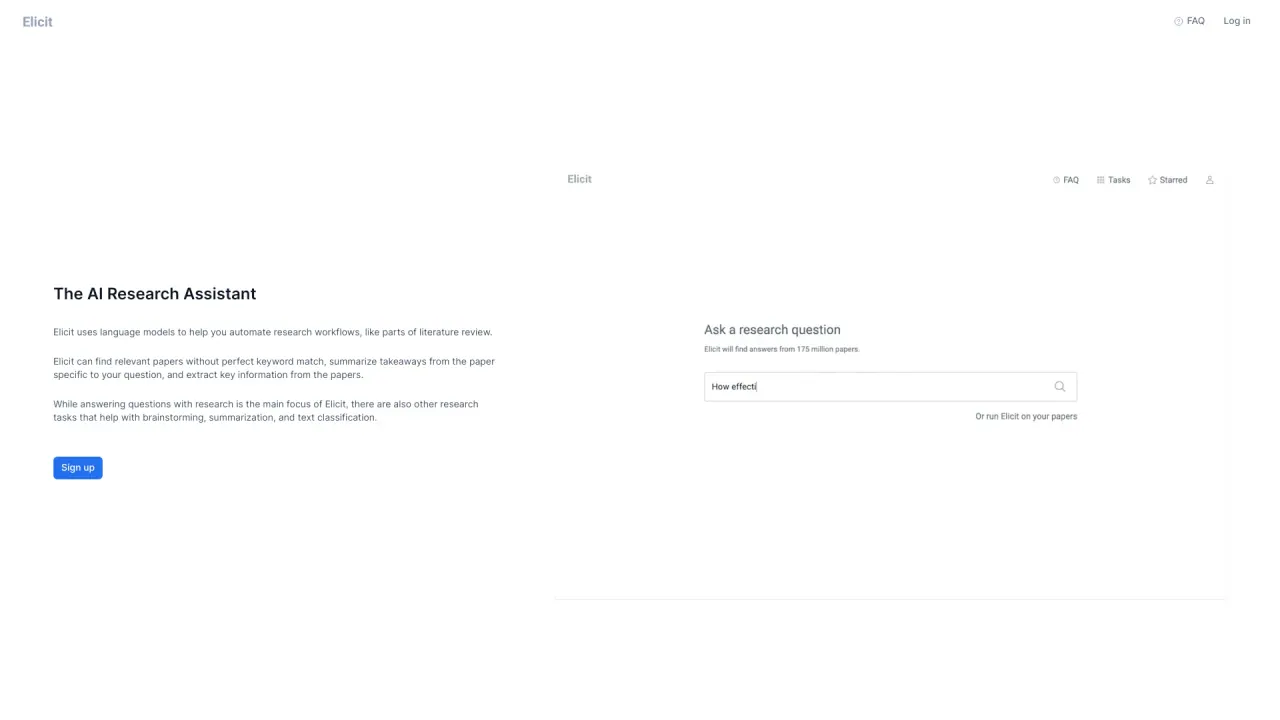
What does Elicit do?
What is Elicit and what can it do for my research?
Elicit is an AI tool designed to help researchers be more evidence-based. It helps you quickly find and understand science by searching a large corpus of literature, generating research briefs, and supporting systematic reviews with customizable outputs. Key capabilities include semantic search over millions of papers and trials, automated research reports, systematic-review assistance, a library to save sources, and alerts to stay updated on new findings.
What data sources does Elicit access?
Elicit can search over 138 million academic papers and 545,000 clinical trials, with more data sources coming soon. For clinical trials, this includes over 545,000 studies on clinicaltrials.gov.
How does Elicit search work?
Elicit uses semantic search, so you don’t need to know every keyword. You can ask in natural language and Elicit will surface relevant papers and data even if exact terms aren’t used.
What are Research Reports and how can they be customized?
Elicit generates high-quality research briefs inspired by systematic reviews. Reports are deeply customizable: you can choose which papers to include and what information to cover, tailoring the output to your needs.
What is the Systematic Literature Review workflow and what benefits does it offer?
Elicit can automate screening and data extraction for systematic reviews, while partially supporting search and report generation. Researchers often report substantial time savings (up to 80%) when using Elicit for systematic reviews.
What is the Library feature?
The Library lets you store and organize sources as you find them, so you can easily reuse them in future projects.
What are Alerts and how do they help me stay updated?
Alerts help you stay on top of new research without cluttering your inbox. They surface relevant findings as they become available.
How does Elicit ensure accuracy and citations for AI-generated claims?
Elicit provides sentence-level citations from the underlying sources for AI-generated claims, supporting transparency and traceability of the extracted information.
How scalable is Elicit? How many papers or data points can it handle at once?
Elicit can find up to 1,000 relevant papers and analyze up to 20,000 data points at once.
Who is Elicit built for? Which industries does it serve?
Elicit supports researchers across many domains and industries, including Pharmaceuticals, Academia, Medtech, Policy & Government, Consumer goods, and Industrials.
What are the latest features added to Elicit?
- Strict Screening and 80-Paper Reports: Systematic Review reports can contain up to 80 papers and use strict screening criteria (DEC 19, 2025).
- Elicit Research Agents: Workflows for competitive landscapes, research landscape, and broad topic exploration (DEC 9, 2025).
- Keyword Search: Elicit Systematic Reviews now supports keyword search queries over Elicit, PubMed, and ClinicalTrials.gov (OCT 23, 2025).
- Clinical Trials: Clinical Trials are now searchable; over 545,000 studies on clinicaltrials.gov can be searched and summarized into tables or reports (JUL 23, 2025).
- Elicit Alerts: Automated, targeted alerts to surface relevant research (JUN 30, 2025).
Are Clinical Trials available in Elicit?
Yes. Elicit now includes Clinical Trials functionality, allowing you to search over clinicaltrials.gov studies and summarize them into tables or reports.
How can I try Elicit or get pricing information?
The site indicates there are multiple pricing options and an Enterprise/Institutions option with custom billing. Exact pricing details are not listed publicly here. You can sign up to try Elicit for free and explore available plans.
Is this your tool?
Claim Elicit to manage this listing, or upgrade to Pro for featured-first placement and a newsletter feature.