
TokenPricing
AI Development Tools
Input, output and cache-read pricing are always kept in separate columns.
- Pricing
- Free
- Category
- Development
- Listed
- Oct 17, 2026
- Updated
- Oct 17, 2026
Promoted


What does TokenPricing do?
TokenPricing is a free, independent LLM API pricing comparison site. Its tagline sums up the goal: "Token pricing. All in one place." You can compare token pricing across providers, explore newly listed models and estimate your API bill without creating an account or signing in.
The homepage counter currently shows 622 models and 237 providers. Every rate is normalized to the same unit, US dollars per 1 million tokens, so an official developer price, a cloud marketplace listing and a third-party API offer can be read side by side without converting units first. Input, output and cache-read pricing are always kept in separate columns.
Why it exists
The same model is often sold by many different platforms at different prices. A model may be available from its own developer, from cloud platforms such as Amazon Bedrock, Azure or Google, and from inference hosts like DeepInfra, Novita, Together, Fireworks, Cloudflare or SiliconFlow. Collecting those numbers by hand means opening dozens of pricing pages and converting per-token rates into a common unit. TokenPricing puts those published offers on one page per model, so you can see the spread at a glance and decide where to run your workload.
Data rules that keep comparisons honest
- Pricing covers standard, global, default-group API usage in USD per 1M tokens.
- Each offer links to the page where its pricing was published, so any number can be checked at its source.
- The first row for a model is its base rate; other rows are additional published provider pricing.
- Missing pricing remains unknown, and a reported zero stays zero. A dash in a table means "not reported", never "free".
- Only active, standard base token rates are included. Batch, region-specific, VIP-group and token-tier offers are left out of the main tables.
- Offers that look wrong are flagged rather than hidden: a price outlier is excluded from price summaries until its billing unit is verified, and an offer with an unverified currency conversion is excluded from summaries too.
- Capabilities are reported metadata, not a performance benchmark, and a published listing is not an endorsement of the provider.
Compare pricing (homepage)
The homepage opens with "Popular model pricing": cards for the models with the highest recent token usage. Each card shows the developer, listing date, context window and number of providers, then lists the cheapest offers with input, output and cache price, plus a button to compare all pricing for that model.
Below the cards is the "Compare model pricing" table. It shows one row per model with listing date, displayed provider, context window, and input, output and cached price per 1M tokens. You can expand a row to compare that model's other offers, search by model or provider name, and filter by 30 days, 90 days or all time. The 30d and 90d filters follow the model's release or listing date, and models with unknown dates appear under All time. Each row also has a "Calculate cost" link that opens the calculator with that offer preloaded.
Model pricing (/models)
The Model pricing page groups models by developer. It currently lists 23 models from 13 developers, including Anthropic, Cohere, DeepSeek, Google, inclusionAI, Meta, MiniMax, NVIDIA, OpenAI, StepFun, Upstage, Xiaomi and Z.ai. Each card shows the listing date, provider count, context window and official input and output price, with a "Most used" badge on high-usage models. Models that are sold only by subscription are labeled "Subscription only" instead of being given an invented token price. The page has its own search box for models and developers.
Model detail pages
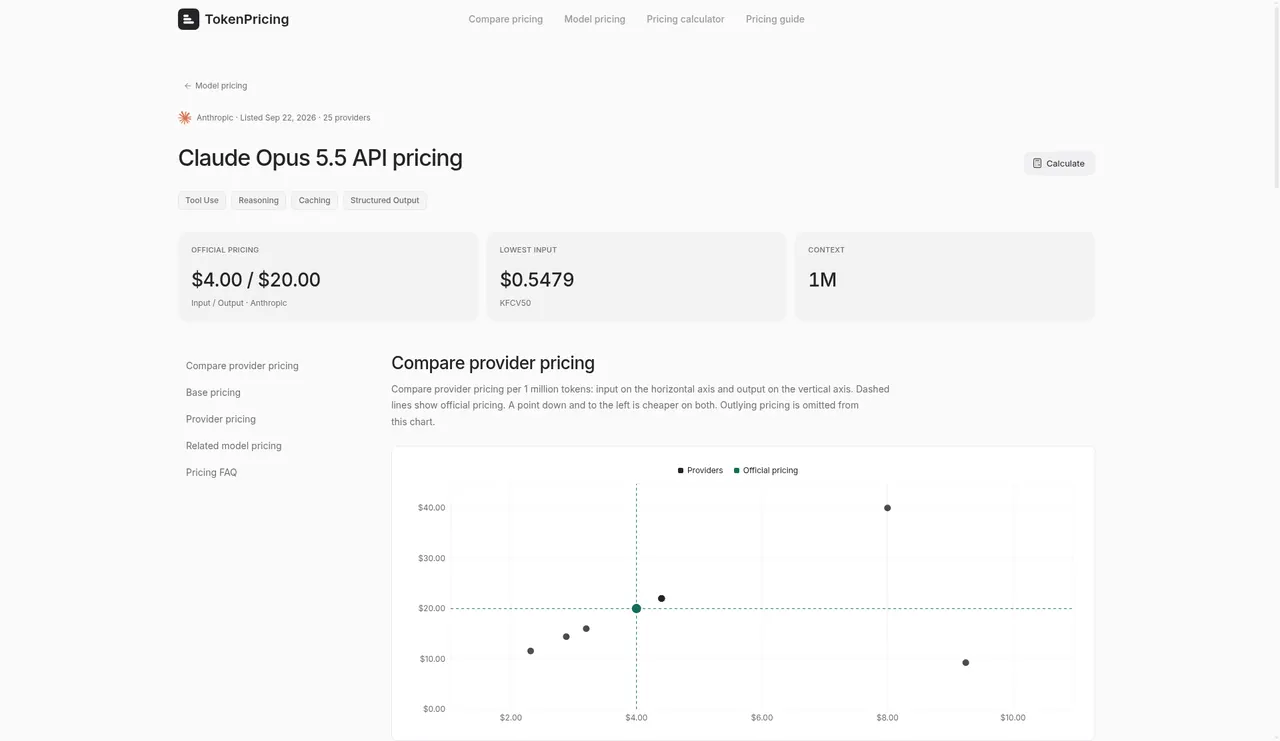
Every model has a dedicated page, for example /anthropic/claude-opus-5.5 or /deepseek/deepseek-v4.1-flash. At the top you see the official input/output price, the lowest available input price and which provider offers it, the context window, and capability tags such as Tool Use, Reasoning, Caching and Structured Output. A weight license panel states whether the model weights are closed/proprietary or open, and names the license where one applies (for example MIT for open weights).
A scatter chart plots every provider with input price on the horizontal axis and output price on the vertical axis. Dashed lines mark official pricing, so a point down and to the left is cheaper on both input and output.
The Base pricing table shows each provider's input, output and cache-read rate, a blended price, and uptime. Where a source publishes them, it also lists cache write (5-minute and 1-hour), web search fees and speed. The blend uses three input tokens for each output token, with half of the input read from cache, which gives a single number for quick ranking. The page also shows the date of the newest pricing check.
A separate Provider pricing table covers additional API providers. It shows the percentage difference versus official pricing, API connectivity and model availability scores, the exact model ID each provider uses, and the provider site's Ahrefs domain rating (DR). The page explains that DR and domain age describe a provider's public footprint and do not show whether it will keep operating; listings under a domain rating of 10 are omitted. Each model page ends with related models and a short pricing FAQ that states the published input price range across its providers.
Pricing calculator (/calculator)
The token pricing calculator estimates an LLM API bill from a single request up to a month of traffic. Step one is to choose published model pricing or enter custom input and output rates. Step two describes the workload: input tokens per request, output tokens per request, requests per month and input cache hit rate. Presets for Chat app, AI agent and High volume fill in typical values.
The result shows the estimated monthly cost, the cost per request, and a breakdown into uncached input, cached input and output. Cached tokens are charged once at the cache-read rate. A "Compare pricing for this workload" list then applies the same usage to other offers. The formula is printed on the page: monthly cost = requests × [(uncached input × input rate + cached input × cache rate + output × output rate) ÷ 1,000,000]. A worked example shows 10,000 requests with 40% cache hits, 1,000 input and 500 output tokens each, at $2 input, $8 output and $0.50 cached input per million, coming to $54.00 per month.
The calculator also gives budgeting advice:
- Measure actual usage, because system prompts, retrieved documents, tool definitions and conversation history all consume input tokens.
- Include reasoning output, since models that bill reasoning tokens charge for them even when they are not visible in the answer.
- Model realistic cache hits, because prompt caches have eligibility rules, minimum lengths and expiration times; 100% caching is rarely a safe assumption.
Estimates exclude taxes, cache writes and storage, request fees and other non-token charges, and the site notes that provider tiers and discounts may change the total.
Pricing guide
The Pricing guide, linked in the main navigation, explains the methodology behind the numbers: pricing units, traceable sources, the dataset license and pricing conditions. It also notes that taxes, cache writes, storage, image and audio billing and per-request tools can add charges beyond token prices.
Who it is for
- Developers choosing which provider to call for a specific model
- Founders and product teams budgeting an AI app or agent before launch
- Teams checking how much prompt caching lowers their bill
- Anyone comparing official pricing with cloud and third-party offers
- Buyers who want each price backed by a link to where it was published
Free and open to use
TokenPricing is free, with no paid plans, no signup and no login. The site is in English and offers light, dark and system themes. Contact: team@tokenpricing.co.
This listing is claimed
Own TokenPricing? Sign in with the email used to claim it to manage this listing, or upgrade to Pro for featured-first placement and a newsletter feature.