FLUX Dev
AI Text to Images Tool
Enter text and easily create AI images with FLUX.1 dev online for free.
Promoted

What does FLUX Dev do?
What is FLUX dev and who is it for?
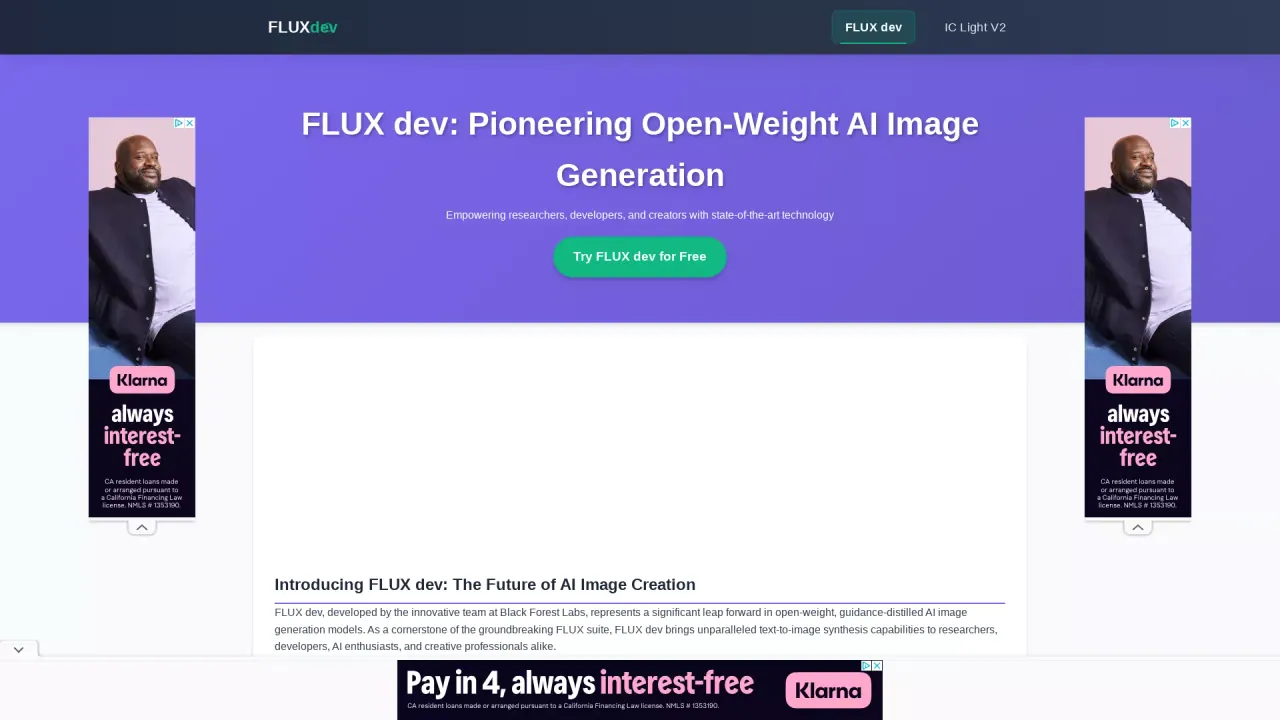
FLUX dev is an open-weight AI image generation model from Black Forest Labs, built on the FLUX [pro] foundation. It uses direct distillation from FLUX [pro], delivers strong prompt adherence, enhanced typography for text-rich images, and improved anatomical accuracy. With support for a wide range of aspect ratios and resolutions, FLUX dev is designed for researchers, developers, AI enthusiasts, and creative professionals. It is ideal for research, experimentation, and non-commercial creative projects.
How can I access FLUX dev and start using it?
You can access FLUX dev via flux-1.net, and it is also available through platforms like Hugging Face and Replicate for integration. Comprehensive documentation and tutorials are provided, and you can join the FLUX community, participate in workshops, and stay updated on features and techniques.
What tasks and capabilities does FLUX dev support?
FLUX dev supports:
- Text-to-image synthesis
- Mastery of complex compositions and spatial relationships
- High-quality typography within images
- Image editing and manipulation
- Style transfer
- Photorealistic renderings and artistic creations
What outputs and formats does FLUX dev support?
FLUX dev is designed to work with a wide range of aspect ratios and resolutions, offering versatility for diverse creative needs.
How well does FLUX dev render text and typography?
FLUX dev provides precision in text rendering, delivering legible words and phrases for designs such as signage, book covers, and branded content.
How accurately does FLUX dev render anatomy, especially hands?
FLUX dev shows enhanced anatomical accuracy compared with earlier open-source models, producing more realistic and proportionate body parts. It is not flawless, but improvements are noticeable.
What is the underlying technology and model size of FLUX dev?
FLUX dev runs on a 12B-parameter open-weight architecture. It uses a hybrid setup of multimodal diffusion transformers, flow matching optimization, and rotary positional embeddings, along with guidance distillation to boost output quality and inference speed. It is open-weight with open API access for developers.
Why is FLUX dev described as open-weight and open-source?
FLUX dev offers an open-weight design, providing transparency and enabling community-driven innovation. It includes direct distillation from FLUX [pro] for quality and performance, and open API access to the ecosystem.
What are the real-world applications of FLUX dev across industries?
- Entertainment and media: concept art, character designs, and environmental assets for films and games
- E-commerce and product design: realistic product renderings and marketing visuals
- Education and research: visual aids, simulations, and interactive learning materials
Its capabilities encompass photorealistic renderings, artistic creations, text-to-image synthesis, and style transfer.
How do I integrate FLUX dev into a project? What’s the quick start?
A quick-start integration guide covers:
- Step 1: Set up your environment (Python and required libraries)
- Step 2: Install FLUX dev (from the official repository or via pip)
- Step 3: Load the model and initialize it
- Step 4: Generate images via FLUX dev’s API
- Step 5: Experiment and refine prompts, settings, and post-processing
What are the core components of FLUX dev's architecture?
- Multimodal Diffusion Transformers
- Flow Matching optimization
- Rotary Positional Embeddings
How does FLUX dev fit into the AI ecosystem and what API access exists?
FLUX dev offers Open API access for developers to build custom applications and services. It is designed to integrate with popular AI frameworks and can be deployed on cloud platforms for scalable use.
What’s on the roadmap for FLUX dev?
The roadmap includes:
- Enhanced multi-modal capabilities (e.g., text, audio, and video inputs)
- Improved fine-tuning mechanisms for custom datasets
- Expanded ecosystem integration with popular tools
- More efficient training and fine-tuning methods
- Ongoing exploration of multimodal systems and AR/VR integration
- Ongoing research and development to improve capabilities and performance
How can I collaborate with FLUX dev?
Collaborative opportunities include:
- Academic partnerships with universities and research institutions
- Industry collaborations for specialized applications
- Community contributions to code, documentation, or novel applications
Are there usage restrictions or licensing terms I should know?
FLUX dev is described as ideal for research, experimentation, and non-commercial creative projects. The scraped content notes this usage focus, but it does not specify detailed licensing terms; please consult official policies for complete licensing information.
This listing is claimed
Own FLUX Dev? Sign in with the email used to claim it to manage this listing, or upgrade to Pro for featured-first placement and a newsletter feature.