
AgileGlow
No longer active
Agile Improvement AI
The Systemic Improvement OS: Prove that relentless improvement delivers real business impact
AgileGlow is no longer available
Promoted
 KurodyneSell the tools from your AI side projects. Listing is free.
 Sidrune AI85% off. Stable Claude API for agent developers. Pay as you go. Invoices & refunds available.
 Pixmax.aiPixmax.ai is an all-in-one AI workspace for videos, visual stories, and marketing content.
 RewindType any X/Twitter handle. Get their year back as a narrated video story. Then ask it anything.
 SEOify - Improve your SEO & rankingsBuild links to rank in Google. Improve your DR with links you can start building now.Advertise here270,000+ people visit Dang.ai every month.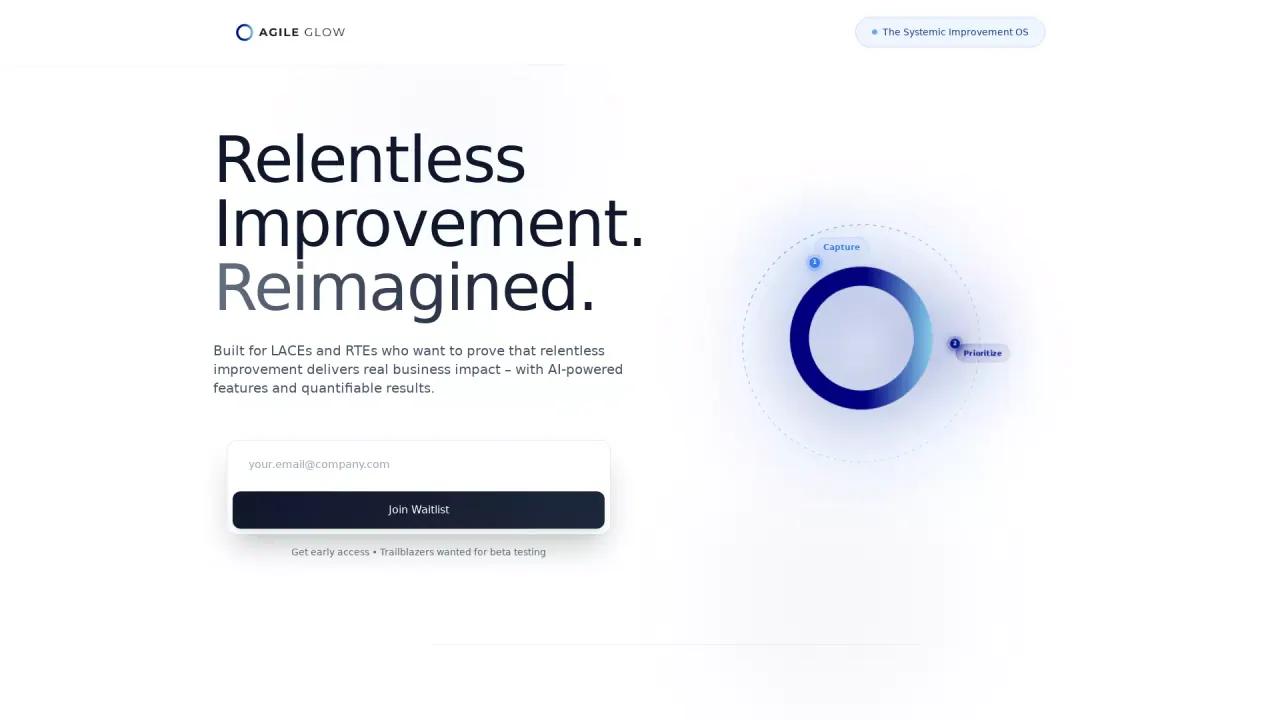
What does AgileGlow do?
What is the main use case for AgileGlow?
For RTEs: Make continuous improvement as visible and manageable as your feature flow
One place for all improvement work across your ART AI supported WSJF for improvement items PI level improvement roadmap Impact dashboard for your ART
For LACEs: Give the transformation a system wide brain instead of fighting train by train
Cross ART visibility Share and scale best practices Ready to use management reports Evidence for real change
Who is the target audience of agileglow.io?
Companies using scaling frameworks such as SAFe, LeSS, or Scrum at Scale
Can a user use AgileGlow for free?
There is a free testing phase, but you cannot use it for free.
How Does AgileGlow Address Challenges in Scaled Agile Organizations?
AgileGlow targets the main pain points in Scaled Agile organizations by providing a dedicated improvement flow. It resolves issues such as improvement work disappearing into Jira by offering a centralized platform that separates improvement tickets from feature work. AgileGlow quantifies the return on effort, allowing organizations to prioritize and measure impact effectively. This provides leadership with clear proof of Agile transformation success, fostering trust and securing funding for further initiatives.
What Features Does AgileGlow Offer to Enhance Continuous Improvement?
AgileGlow enhances continuous improvement through several AI-powered features. It captures improvement ideas quickly, prioritizes them using WSJF scoring, and employs root cause analysis to create structured improvements. AgileGlow tracks the impact of improvements on flow, quality, and team performance using measurable metrics. This tool transforms top improvement ideas into actionable items, ensuring readiness and facilitating a clear line from initiatives to business results.
How Can AgileGlow Help Agile Leaders Manage Systemic Improvement Work?
AgileGlow enables Agile leaders, such as RTEs and LACE members, to manage systemic improvement work effectively by providing dedicated spaces for capturing and tracking improvements. It offers an AI-supported WSJF for prioritizing items with the highest return on effort and a PI-level improvement roadmap to track progress. The tool's impact dashboard visualizes changes at both the ART and system-wide levels, allowing leaders to make informed decisions based on data and not just practice compliance.