Old English Translator
AI Translator & Translation Tools
Free AI tool to translate between modern English and Old English (Anglo-Saxon), with drafts that use þ, ð, and æ.
- Pricing
- Free
- Category
- Translation
- Listed
- Nov 14, 2026
- Updated
- Nov 14, 2026
Promoted
 RewindType any X/Twitter handle. Get their year back as a narrated video story. Then ask it anything.
 KurodyneSell the tools from your AI side projects. Listing is free.
 Pixmax.aiPixmax.ai is an all-in-one AI workspace for videos, visual stories, and marketing content.
 AI Checker PlusAI detector that highlights which passages AI wrote. Free check, no sign-up. Plagiarism too.
 SEOify - Improve your SEO & rankingsBuild links to rank in Google. Improve your DR with links you can start building now.Advertise here330,000+ people visit Dang.ai every month.
What does Old English Translator do?
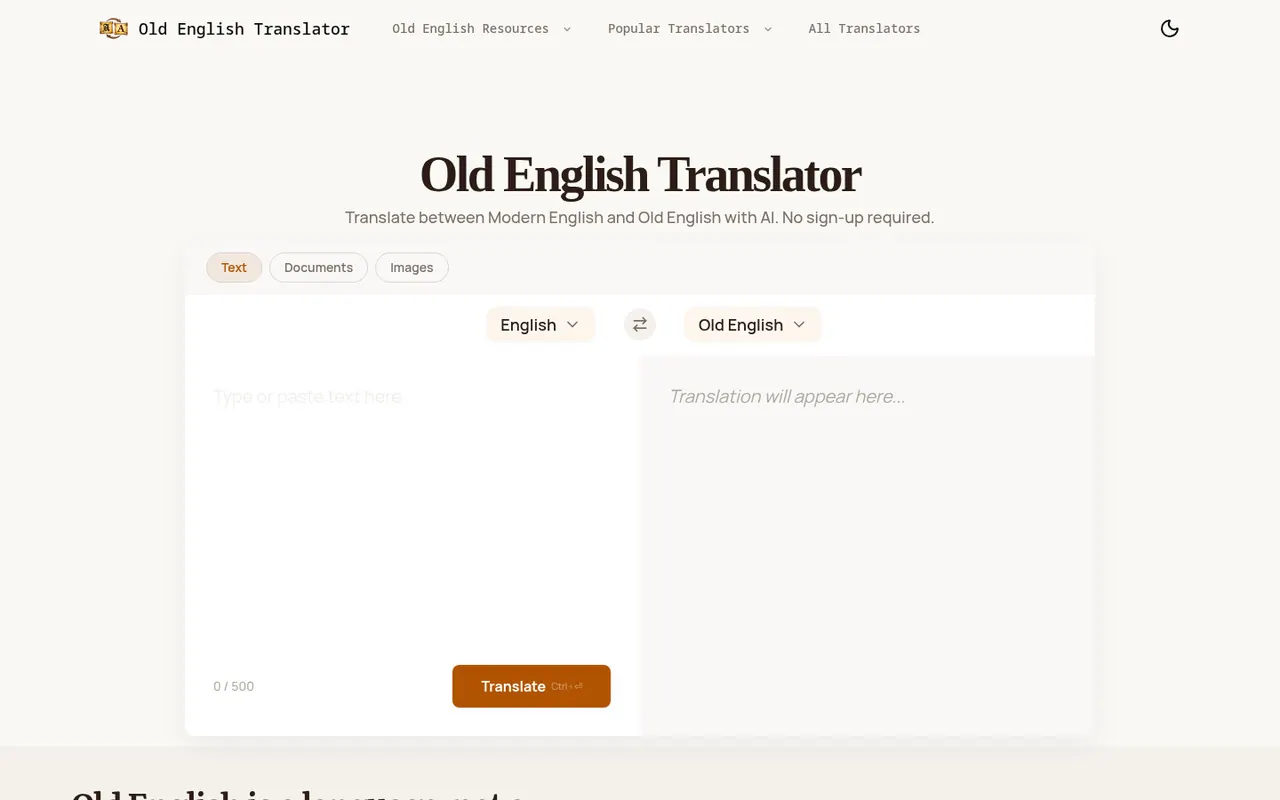
Old English Translator helps you explore Old English (Anglo-Saxon) by converting between modern English and Old English using AI. It’s designed as a quick bridge for study and creative work, letting you compare how wording shifts across time while you learn vocabulary, grammar patterns, and tone.
You can translate text in a few ways: type or paste a sentence, upload a document, or use an image. Enter your modern English, choose Translate, and you’ll get an AI-generated Old English draft that includes key Old English characters like þ, ð, and æ. You can also flip the direction to translate Old English back into modern English for comparison.
To support learning, the tool comes alongside an Old English dictionary search, an alphabet and keyboard guide for the teaching characters (including a browser keyboard), and an Old English phrase collection with context and labeled forms. Use these resources together to refine your drafts and understand how examples work in practice.
It’s especially useful for students and academics, writers and fiction authors, historians and researchers, language enthusiasts, and game/film creators. Old English Translator is free and requires no sign-up.
What does Old English Translator do?
It translates between modern English and Old English (Anglo-Saxon) using AI, producing a draft you can copy for study or creative exploration.
How do I translate modern English to Old English?
Type or paste your modern English into the input box (up to the tool’s limit), then select Translate to generate an Old English draft. You can copy the result afterward.
Can I translate Old English back into modern English?
Yes—switch the translation direction to compare an Old English passage with modern English wording.
Do I need an account to use it?
No account is needed, and it’s available without sign-up.
Does the output include Old English letters like þ, ð, and æ?
Yes. The generated Old English uses key characters such as þ, ð, and æ.
Is the translator suitable for publication or quotations?
It can be a strong draft for exploration, but Old English has dialects, manuscript traditions, and context that a short translation may not fully resolve. For final use, compare with a reliable edition or a qualified Old English reader.
This listing is claimed
Own Old English Translator? Sign in with the email used to claim it to manage this listing, or upgrade to Pro for featured-first placement and a newsletter feature.