
AutonomyGradient
AI Engineering Automation
Autonomy Gradient visualizes how AI automation shifts execution authority in engineering from assistance to validated autonomy.
Promoted
 Sidrune AI85% off. Stable Claude API for agent developers. Pay as you go. Invoices & refunds available.
 Pixmax.aiPixmax.ai is an all-in-one AI workspace for videos, visual stories, and marketing content.
 SEOify - Improve your SEO & rankingsBuild links to rank in Google. Improve your DR with links you can start building now.Advertise here270,000+ people visit Dang.ai every month.
What does AutonomyGradient do?
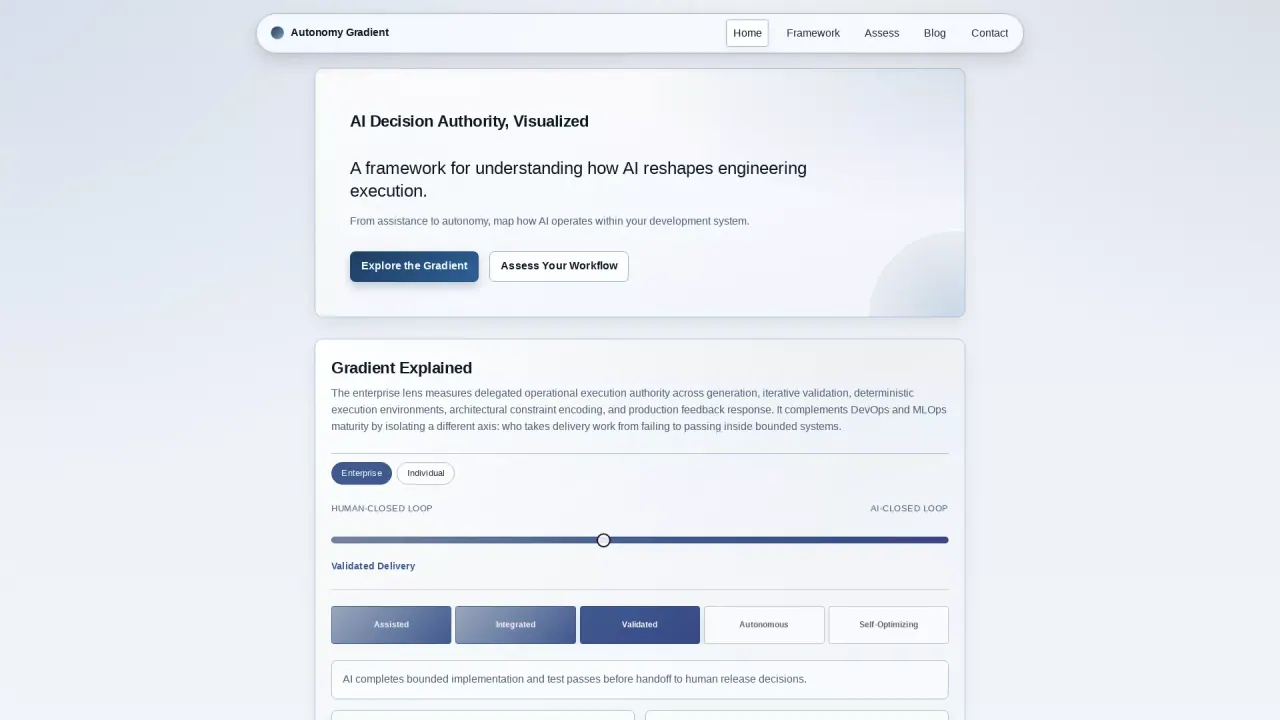
Autonomy Gradient is a framework for understanding and mapping how AI reshapes engineering execution. It helps you see the movement along an “autonomy gradient,” from AI-assisted work through validated delivery, to more autonomous cycles—while keeping clear boundaries around where responsibility and control sit.
The framework focuses on how AI operates within your development system, including how AI handles generation and iterative validation, how deterministic execution environments behave, how architectural constraints are encoded, and how production feedback responses close the loop. An enterprise lens measures delegated operational execution authority across these steps, offering a different perspective than traditional DevOps or MLOps maturity: who takes delivery work from failing to passing within bounded systems.
It’s designed for individual engineers, development teams, operational managers, and system architects who want a clearer picture of their workflow posture. The tool can assess your workflow and map where you sit on the gradient, including roles like strategic oversight and risk governance, architectural gatekeeping, and how validation ownership may shift from human checkpoints to automated verification loops.
Pricing and usage: the framework is open source, and the assessment tool is free to use. Non-commercial, unmodified sharing is permitted under CC BY-NC-ND 4.0, while commercial publication, licensing, and derivative rights are reserved.
What does Autonomy Gradient help me understand?
It helps you map how AI affects engineering execution authority—moving from assistance toward AI-closed loop work while clarifying what stays under human release decisions.
What is the main difference between this framework and DevOps/MLOps maturity models?
It adds an “execution authority” axis—focusing on who takes delivery work from failing to passing inside bounded systems, rather than only process maturity.
Who is Autonomy Gradient for?
Individual engineers, development teams, operational managers, and system architects who want to evaluate and describe how AI supports or automates parts of their delivery workflow.
How does the assessment work?
You describe your workflow, and it maps your position on the gradient—covering aspects like validation ownership, bounded AI loops, and how exceptions are handled.
Is the assessment tool free to use?
Yes. The framework is open source, and the assessment tool is free to use.
Can I use the framework commercially or modify it?
Non-commercial, unmodified sharing is permitted under CC BY-NC-ND 4.0. Commercial publication, licensing, and derivative rights are reserved.
This listing is claimed
Own AutonomyGradient? Sign in with the email used to claim it to manage this listing, or upgrade to Pro for featured-first placement and a newsletter feature.