
Atlas
Knowledge Management Tool
Atlas is a free knowledge workspace that helps you research, organize notes, and synthesize sources with cited answers and interactive maps.
Promoted
 RewindType any X/Twitter handle. Get their year back as a narrated video story. Then ask it anything.
 KurodyneSell the tools from your AI side projects. Listing is free.
 Sidrune AI85% off. Stable Claude API for agent developers. Pay as you go. Invoices & refunds available.
 Pixmax.aiPixmax.ai is an all-in-one AI workspace for videos, visual stories, and marketing content.
 SEOify - Improve your SEO & rankingsBuild links to rank in Google. Improve your DR with links you can start building now.Advertise here270,000+ people visit Dang.ai every month.
What does Atlas do?
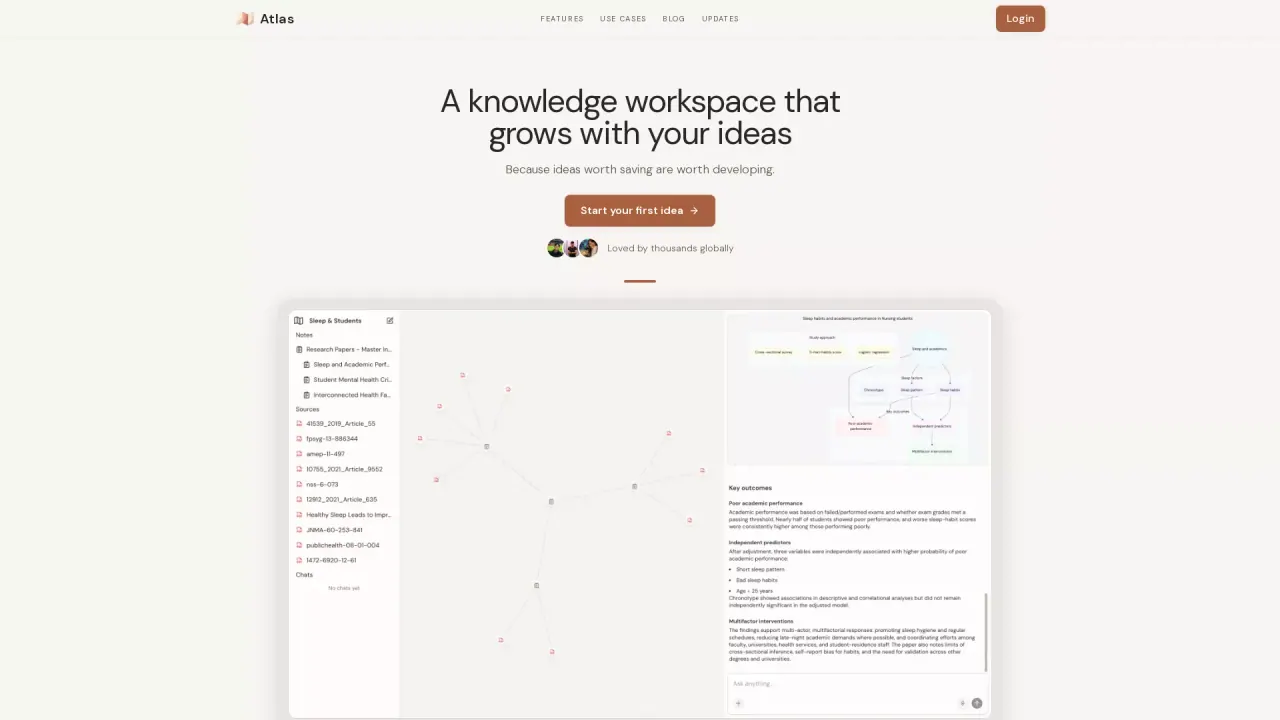
Atlas is a visual, verifiable AI research assistant and knowledge workspace designed to help you understand and synthesize literature in one place. It connects what you read, write, and ask so your research question, sources, notes, and maps stay linked as your understanding grows.
Use Atlas to find relevant research, explore evidence, and build a grounded literature review. Start by searching scholarly literature from your research question, then inspect results and add relevant papers to your project. When you need deeper understanding, analyze papers with editable knowledge maps and ask about methods, findings, or concepts—backed by cited sources you can open to verify the evidence.
Atlas also supports synthesis across multiple sources. Compare findings across your papers, explore connections on a semantic map, and develop cited synthesis notes. You can ask questions across your project and trace each claim back through an indexed citation trail to the exact passage that supports it.
For the workspace itself, Atlas turns highlights and ideas into notes that remain attached to their evidence, and it lets you export notes and download knowledge maps when you need to use your work elsewhere. Atlas is free, and integrates multiple source types such as PDFs, websites, notes, slides, documents, arXiv, PubMed/PMC, OpenAlex, Semantic Scholar, DOI/CrossRef, and YouTube.
What can I do with Atlas for research?
Atlas helps you find relevant papers, analyze documents with knowledge maps, and synthesize findings into notes and maps. It keeps your research question, sources, and citation trail together while you work.
How does Atlas help me verify where an answer comes from?
Atlas grounds answers in your sources and provides cited responses. You can trace a claim back through an auto-indexed citation trail to the exact passage that supports it.
What kinds of sources can I add to Atlas?
Atlas supports inputs like PDFs, web articles/websites, notes, slides, documents, arXiv, PubMed/PMC, OpenAlex, Semantic Scholar, DOI/CrossRef, and YouTube. You can also start from a transcript when available for video summarization.
Can Atlas organize my notes and maps automatically?
Yes. Atlas turns highlights and ideas into linked notes and helps you build interactive knowledge and semantic maps. Links you create become context for future questions within your workspace.
Is Atlas free to use?
Yes. Atlas is free to start researching.
Who is Atlas best for?
Atlas is designed for researchers and students who need a structured way to read, verify, and synthesize sources. It’s also useful for analysts who work with lots of documentation and need traceable, source-backed summaries and synthesis.
This listing is claimed
Own Atlas? Sign in with the email used to claim it to manage this listing, or upgrade to Pro for featured-first placement and a newsletter feature.