
Hex Magic
AI Analytics Platform
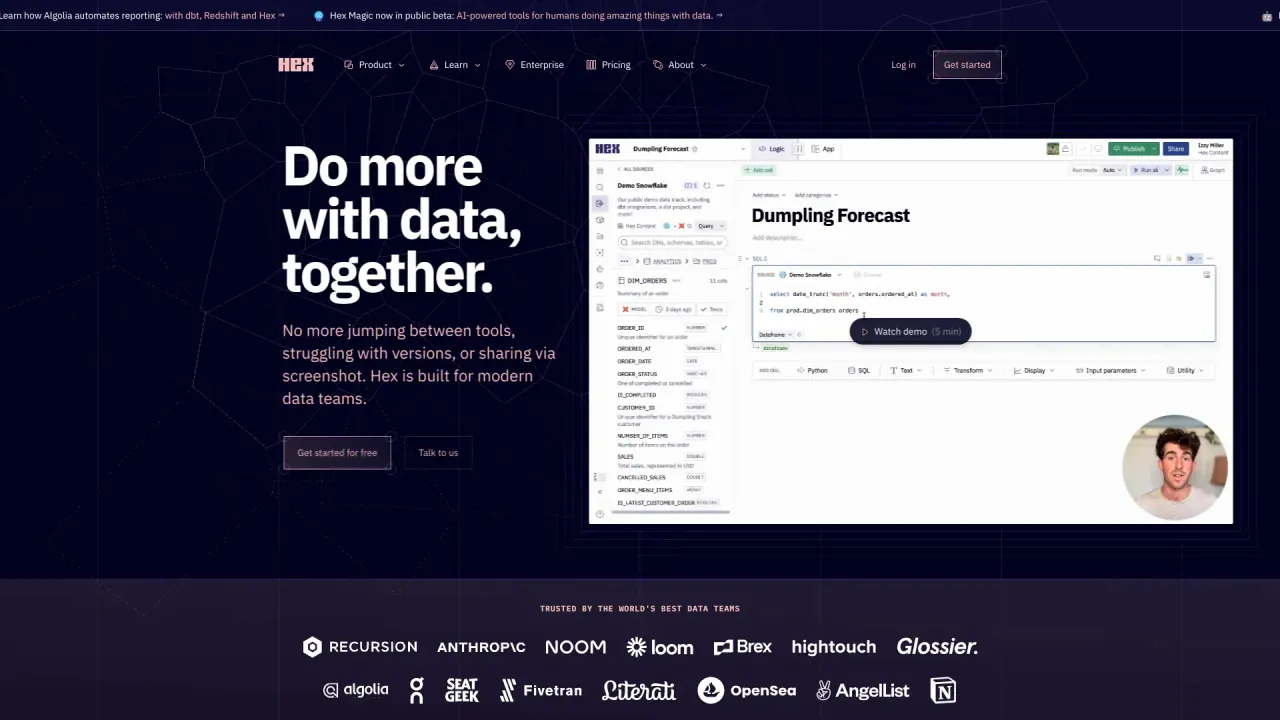
Revolutionize your analytics workflow with Hex Magic's AI-powered code generation and debugging tools. Experience true collaboration with our intuitive AI Analytics Platform.
- Pricing
- Freemium
- Listed
- Aug 4, 2023
- Updated
- May 25, 2026
What does Hex Magic do?
What is Hex and what are its core capabilities?
Hex is a collaborative analytics platform that blends notebooks, AI-powered agents, and data apps in one integrated workspace. Its core capabilities include: agentic notebooks for deep-dive analyses, conversational self-serve via Threads, context studio for semantic models and AI governance, data apps and embedded analytics, and out-of-the-box integrations and flexible APIs to connect your data stack.
What new features did the Spring Release 2024 include for Hex?
The Spring Release 2024 introduces spreadsheet-style calculations, no-code data browsing, and enhancements to AI tools that can generate queries, write code, create visualizations, and fix bugs from prompts. These improvements aim to make Hex more accessible and productive for a broader range of users.
How do Hex's AI tools improve data analysis?
Hex's AI tools can generate data queries, write code, create visualizations, fix data issues, and help kickstart analyses from simple prompts. They’re designed to help you move from quick questions to deep analyses faster and with less manual coding.
What makes Hex a collaborative platform for data teams?
Hex supports collaboration through features like feedback workflows, endorsement of trusted data, reusable components, and shared workspaces. Teams can work together on projects, review differences, and align with stakeholders in one place.
What are Agentic notebooks and Notebook Agent?
Agentic notebooks are Hex notebooks that include built-in AI agents to help you go deeper into analyses. The Notebook Agent assists with exploring questions, generating insights, and helping you build reports and dashboards more efficiently.
What is Context Studio?
Context Studio is Hex’s governance and context layer for building semantic models and AI governance rules. It helps establish trust in data by providing structured context and control over how AI analyzes and presents data.
What is a semantic model in Hex, and how do I use it?
A semantic model defines the structure, dimensions, and measures that describe your data and govern AI-driven analyses. You author and publish semantic models in Hex to ensure consistent context, governance, and trustworthy results across your analyses.
What is the Galactic Sales Model?
The Galactic Sales Model is a sample semantic model within Hex (an example in the Galactic Sales data domain) that defines dimensions like product_line, region, and customer_sector. It demonstrates how semantic models structure data for AI-driven queries and visualizations.
How do I start evaluating Hex?
Getting started is simple: sign up for a free starter experience, explore the docs and guides, and connect your data sources or upload sample data. For deeper onboarding, you can follow the Switching to Hex guide and request a demo.
How does Hex ensure AI answers are accurate and trustworthy?
Hex emphasizes governance and context through semantic models and Context Studio. By structuring data context, defining trusted data, and applying AI governance, Hex aims to improve the reliability and trustworthiness of AI-generated insights.
Do I need to build semantic models in Hex?
Semantic models are available to provide structured context and governance for AI analyses. They’re highly beneficial for ensuring consistent interpretation of data, but building them is optional depending on your governance needs.
How do I connect Hex to my data stack?
You have two options:
- Manual data upload: upload CSV, JSON, or Excel files in a project and query them with SQL cells.
- Data connection setup: connect to databases or data warehouses (e.g., Snowflake, Redshift, BigQuery) or data lakes (e.g., S3). Add connections in the Data Sources area and query directly from the established connections.
What integrations does Hex support?
Hex offers out-of-the-box connections and flexible APIs, including built-in connections to Snowflake, BigQuery, and Databricks, plus support for S3 and other data sources. It also integrates with dbt, GitHub, GitLab, Airflow, Dagster, Prefect, and more.
What is Hex API?
Hex provides a public API to write custom integrations and extend Hex’s capabilities beyond the built-in features and connectors.
What is Threads?
Threads is Hex’s conversational self-serve environment that lets you ask questions in natural language (and with some tools, via Slack or other integrations) and get immediate data answers. It pairs natural language queries with interactive visualizations and BI-style explorations.
How do I sign up or start for free?
You can get started for free by clicking the “Get started for free” option. Sign up using Google, Microsoft, or email, create your workspace, and begin connecting data sources or uploading datasets to explore Hex right away.
How do I switch to Hex? Is there a guide?
Yes. There is a guide titled Switching to Hex that walks you through getting started with agentic analytics, onboarding steps, and initial setup.
What is the difference between Hex and other AI analytics platforms?
Hex combines notebook-based analytics, AI-powered agents, and data apps in one platform, with built-in governance via semantic models and Context Studio, plus collaborative features designed for data teams. It emphasizes agentic workflows and integrated, end-to-end data experiences.
What security features does Hex offer?
Hex emphasizes enterprise-grade security and control, including support for single sign-on (SSO), SCIM for user provisioning, and secure connections through OAuth. It also highlights governance and trust features via semantic models and Context Studio.
Where can I find docs, guides, and changelog?
Hex provides dedicated sections for Docs, Guides, Changelog, Blog, Resources, and templates. These resources cover product guides, tutorials, and release updates to help you learn and adopt Hex quickly.
Is this your tool?
Claim Hex Magic to manage this listing, or upgrade to Pro for featured-first placement and a newsletter feature.