TalorData
Verified
AI Search Engines List
Use TalorData’s SERP API to fetch structured Google, Bing, Yandex, and DuckDuckGo results for AI, RAG, and SEO workflows.
- Pricing
- Free trial
- Category
- Search
- Listed
- Jul 13, 2026
- Updated
- Jul 14, 2026
Promoted
 Pixmax.aiPixmax.ai is an all-in-one AI workspace for videos, visual stories, and marketing content.
 Sidrune AI85% off. Stable Claude API for agent developers. Pay as you go. Invoices & refunds available.
 SEOify - Improve your SEO & rankingsBuild links to rank in Google. Improve your DR with links you can start building now.Advertise here270,000+ people visit Dang.ai every month.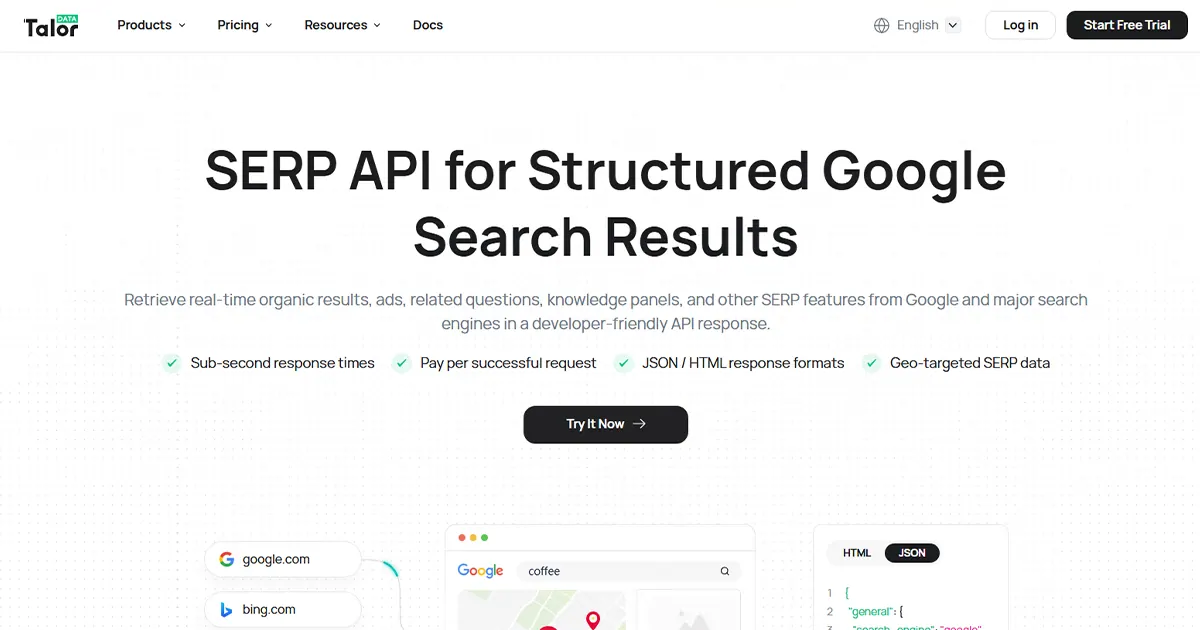
What does TalorData do?
TalorData’s SERP API returns structured search results from Google, Bing, Yandex, and DuckDuckGo through a single API. Responses are formatted for direct use in automated systems, including AI agents and retrieval workflows.
This API is positioned for search-data use cases like SEO monitoring and competitor/brand visibility, where you need consistent parsing of organic results and key SERP features. It also supports low-latency AI search scenarios, helping systems ingest fresh SERP content when generating answers.
For higher-scale automation, TalorData also emphasizes agent integration with high-concurrency capabilities for multi-step tasks. You can use output options like HTML or JSON to fit your pipeline requirements.
Which search engines does TalorData’s SERP API support?
It supports Google, Bing, Yandex, and DuckDuckGo. Queries can be run through one API for standardized results.
What kind of output does TalorData provide?
You can choose output formats such as HTML or JSON. The results are returned in a structured form suitable for downstream automation.
Is TalorData suited for SEO monitoring and competitor tracking?
Yes—it's designed for SEO rank tracking and SERP layout/feature parsing over time, which helps with brand and competitor monitoring.
Can I use TalorData for AI agents and RAG workflows?
Yes. The API is built for AI agents, AI search, and RAG-style retrieval where SERP data needs to be ingested programmatically.
Does TalorData charge per response or on a different basis?
Pricing is described as pay only for successful requests, with a starting rate listed as $0.25 per 1K responses per month. Check the pricing page for current details.
Is there a free option to try TalorData?
Yes. A free trial is available, including access to 1000 responses.
This listing is claimed
Own TalorData? Sign in with the email used to claim it to manage this listing, or upgrade to Pro for featured-first placement and a newsletter feature.