
DeepSeek Harness Guide by SpringBrand
Verified
AI Chatting Tools
DeepSeek Harness (dsh) is an MIT-licensed, plugin-first agent runtime built on Cordis, with a local web UI and configurable execution modes.
Promoted
 Sidrune AI85% off. Stable Claude API for agent developers. Pay as you go. Invoices & refunds available.
 Pixmax.aiPixmax.ai is an all-in-one AI workspace for videos, visual stories, and marketing content.
 AI Checker PlusAI detector that highlights which passages AI wrote. Free check, no sign-up. Plagiarism too.
 RewindType any X/Twitter handle. Get their year back as a narrated video story. Then ask it anything.
 KurodyneSell the tools from your AI side projects. Listing is free.
 SEOify - Improve your SEO & rankingsBuild links to rank in Google. Improve your DR with links you can start building now.Advertise here270,000+ people visit Dang.ai every month.
What does DeepSeek Harness Guide by SpringBrand do?
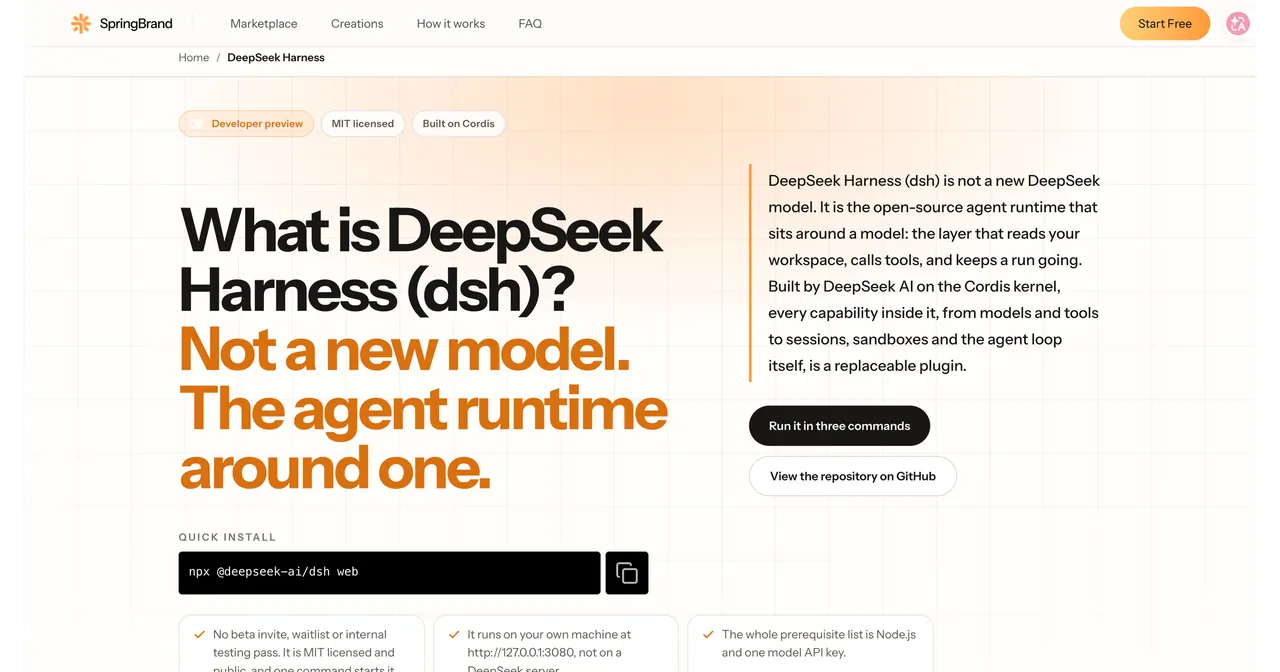
DeepSeek Harness (dsh) is a framework for building agent harnesses—not a finished coding agent product. It gives a model a workspace, tool registry, permissions/sandbox, and an append-only session log, then runs an agent loop that keeps the work moving. The core idea is that “everything is a plugin,” so you extend and reshape the runtime through configuration rather than changing a privileged core.
Under the harness sits Cordis, the plugin kernel that mounts, unmounts, and reconnects plugins for a running dsh instance. Model adapters, tools, sessions, sandboxes, storage, and the agent loop are all provided as plugins. Because plugin registration is tied to the plugin’s lifecycle, unloading a plugin removes its registrations automatically—making capabilities swappable by configuration. DeepSeek Harness also supports an inspectable run model: everything visible to the agent is captured in an append-only session event stream, enabling trace, resume, fork, search, and replay.
dsh is designed for developers, plugin authors, and teams who want to own their agent runtime and keep it inspectable and remixable. It’s also explicitly positioned as developer preview, with compatibility-breaking changes expected. It’s not the best fit for production deployments requiring stable API guarantees today, or for teams seeking a hosted/managed service instead of software they run themselves.
Key requirements include Node.js 22.19+ or 24+, and it runs a local web UI by default at http://127.0.0.1:3080. The project is MIT licensed, and published capabilities are accessible via a plugin ecosystem (including Cordis profiles, bundles, and patch layers).
What is DeepSeek Harness (dsh) and how is it different from a model?
dsh is the agent harness runtime that provides a workspace, tool registry, permissions/sandbox, and an agent loop. It does not train, host, or replace a model—it generates no weights itself and uses whichever provider you configure.
What is Cordis in DeepSeek Harness?
Cordis is the plugin kernel underneath dsh. It mounts, unmounts, and reconnects plugins and manages their dependencies and typed events so capabilities can be swapped without privileged core changes.
Why do people confuse “DeepSeek Harness” with another project also named dsh?
Two unrelated projects share the name DeepSeek Harness and both provide a command called dsh. This page covers the official DeepSeek AI TypeScript harness (local web UI, Node.js) and not the separate community Python client.
How does the plugin architecture work in dsh?
A running instance is built as a plugin tree from layered sources (bundles and profile patch layers). Capabilities are exposed through plugin “seams” (service definition, provider(s), and consumers), and later patch layers replace targeted configuration rows rather than deep-merging.
What does DeepSeek Harness log during a run?
Every model-visible fact is appended to an append-only session log, including prompts, tool calls and results, context injections, and subagent scheduling. Actions like resume, fork, search, and replay operate from this shared event stream.
Is DeepSeek Harness ready for production?
It’s in developer preview, and compatibility-breaking changes are expected. If you need stable API stability today, it’s better to wait or plan for potential updates.
This listing is claimed
Own DeepSeek Harness Guide by SpringBrand? Sign in with the email used to claim it to manage this listing, or upgrade to Pro for featured-first placement and a newsletter feature.