
Coral
Verified
AI Search Engines List
Coral turns APIs, databases, and files into read-only SQL schemas so agents can query and JOIN across sources in one place.
Promoted
 KurodyneSell the tools from your AI side projects. Listing is free.
 Sidrune AI85% off. Stable Claude API for agent developers. Pay as you go. Invoices & refunds available.
 Pixmax.aiPixmax.ai is an all-in-one AI workspace for videos, visual stories, and marketing content.
 RewindType any X/Twitter handle. Get their year back as a narrated video story. Then ask it anything.
 SEOify - Improve your SEO & rankingsBuild links to rank in Google. Improve your DR with links you can start building now.Advertise here270,000+ people visit Dang.ai every month.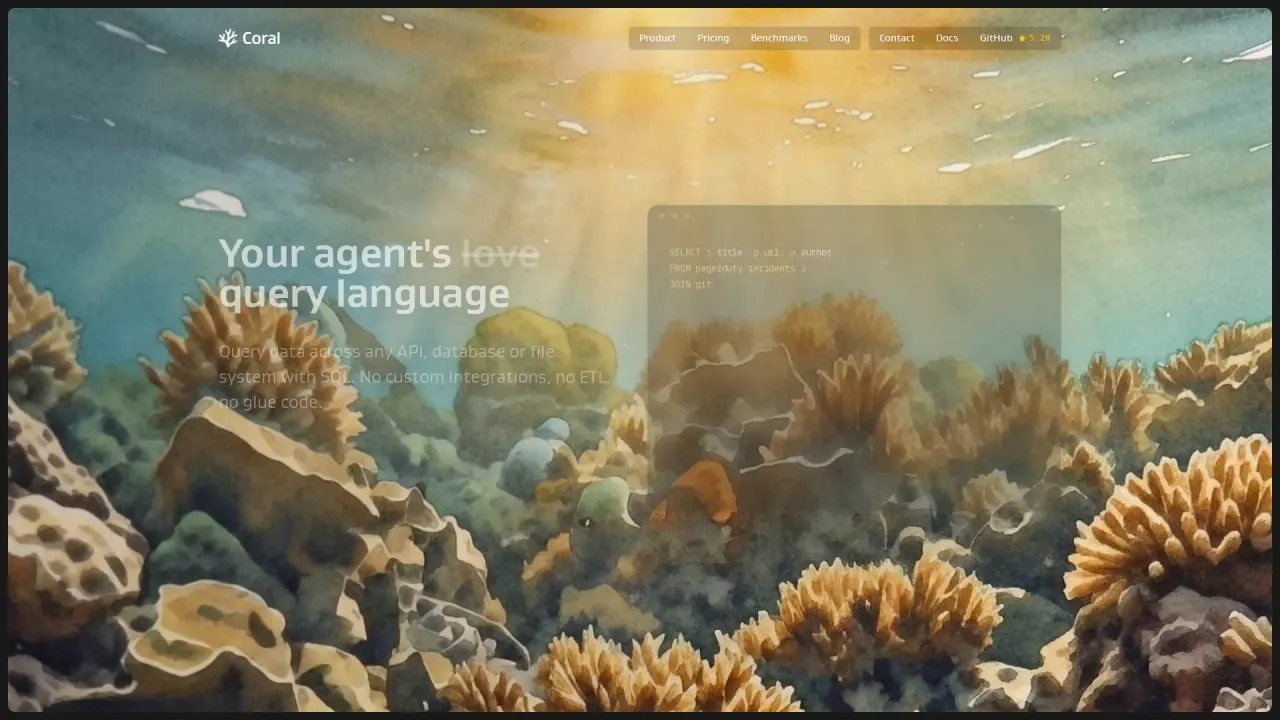
What does Coral do?
Coral is a SQL query layer for agents that exposes any connected API, database, or file system as a read-only schema. Instead of making agents call one tool at a time and stitching results together, you can write a single SQL query with JOINs across sources.
Coral handles authentication, pagination, rate limits, and schema mapping for you. It also supports column-level access controls so you can scope exactly what an agent can see.
Designed to run efficiently on real workloads, Coral uses query pushdown, caching, and pagination to reduce unnecessary API calls and token-heavy loops. It also learns from query patterns over time to improve discovery and execution.
You can use Coral from the CLI or via MCP, and it is open source under Apache 2.0.
What does “read-only” mean in Coral?
Coral is designed as a query layer for reading data from connected sources. It exposes schemas for agents to query without mutating upstream systems.
How does Coral help agents avoid “tool stitching”?
Coral turns multiple sources into queryable tables so you can use standard SQL (including JOINs) to answer cross-source questions in a single query.
Does Coral require ETL or custom integrations?
No. Coral connects sources and provides a unified, queryable schema without ETL pipelines or glue code.
What does Coral handle for me when querying sources?
Coral manages authentication, pagination, rate limits, and schema mapping so queries can run reliably across different data sources.
Can I restrict what an agent can access?
Yes. Coral provides column-level access controls so you can choose what each agent can see from a given source.
How can I plug Coral into my agent workflow?
Use it either from the CLI or via MCP to share one runtime across agents.
Is this your tool?
Claim Coral to manage this listing, or upgrade to Pro for featured-first placement and a newsletter feature.