
BechdelTest
Film & Movie AI Tools
BechdelTest is an AI-powered checker that evaluates whether movies and scripts pass the Bechdel Test for women’s representation.
- Pricing
- Free
- Category
- Film
- Listed
- Jul 28, 2026
- Updated
- Jul 28, 2026
Promoted


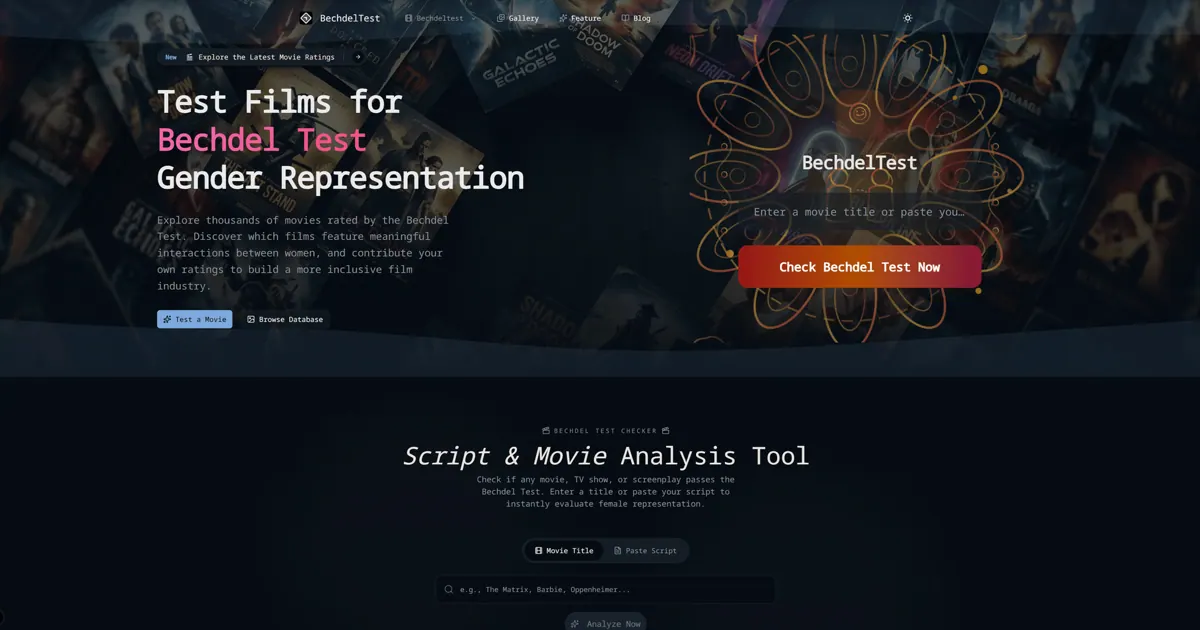
What does BechdelTest do?
BechdelTest helps you evaluate female representation in film and media using the Bechdel Test. It analyzes either a movie title or a screenplay/script you paste in, then determines whether the material passes, fails, or is disputed.
Use the Movies tool to scan a title and get results tied to the three criteria: at least two named women, they talk to each other, and their conversation is about something other than a man. You can also browse the database to explore ratings, discussions, and patterns across films.
For deeper review, use the Scripts tool by pasting a full screenplay or excerpt. It parses scenes and dialogue to provide per-criterion pass/fail outcomes, counts of named female characters, conversation topic analysis, and a scene-by-scene breakdown to support interpretation and sharing. The tool is free and doesn’t require registration.
What are the three Bechdel Test criteria?
A film passes if it includes at least two named women, those women have a conversation with each other, and their conversation is about something other than a man.
Can I test a movie title instead of pasting a script?
Yes—use the Movies tool to enter a movie title and get an AI evaluation against the three criteria.
What should I paste into the Scripts tool?
Paste a full screenplay or an excerpt. The analysis breaks down scenes and dialogue to produce results for each Bechdel Test criterion.
If a movie fails the test, does that mean it’s sexist?
No. Passing doesn’t automatically make a film feminist, and failing doesn’t automatically make it sexist—the Bechdel Test is a minimal benchmark for representation.
Why do unnamed or background women not count toward the test?
The first criterion requires at least two women who are given names; unnamed or background characters don’t satisfy that rule.
Are the site ratings always definitive?
No—ratings can be disputed, and community discussion helps interpret and review assessments.
This listing is claimed
Own BechdelTest? Sign in with the email used to claim it to manage this listing, or upgrade to Pro for featured-first placement and a newsletter feature.