
Flux Kontext
AI Images Edit Tool
Try Flux.1 Kontext to Edit Images for Free
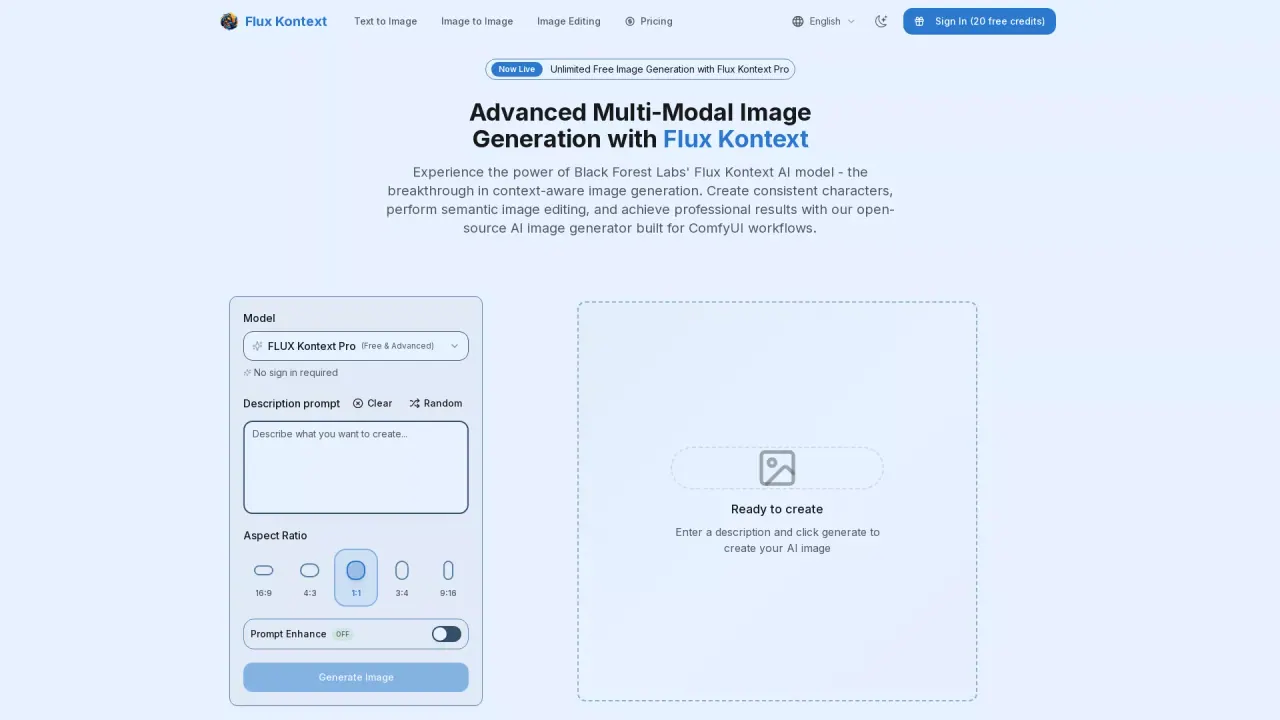
What does Flux Kontext do?
What is Flux Kontext's character consistency capability?
Flux Kontext delivers 94.7% character consistency across image sequences, the highest accuracy reported among open-source AI models. This ensures character identity remains stable across multiple generations, making it ideal for character design and brand visual consistency.
How can I get started with Flux Kontext?
You can start by using the web interface, downloading model weights from the GitHub repository, or integrating Flux Kontext into a ComfyUI workflow. The platform provides tutorials, API documentation, and demo examples to help you begin quickly.
Is Flux Kontext open source, and where can I access the code and weights?
Yes. Flux Kontext is open source under Black Forest Labs’ license. You can access the GitHub repository for model weights, training code, ComfyUI nodes, and comprehensive documentation.
Does Flux Kontext support text-to-image and image-to-image generation?
Yes. Flux Kontext is a multi-modal image generation model that handles both text prompts and image inputs, enabling text-to-image generation, image-to-image transformations, and style-aware editing with context preservation.
Can Flux Kontext integrate with ComfyUI, and what does that involve?
Yes. Flux Kontext integrates with ComfyUI, featuring custom nodes and advanced parameter controls to support professional-grade workflows and complex image-generation pipelines.
What is Reference Image AI Generation in Flux Kontext?
Flux Kontext can use reference images to guide generation while maintaining style and visual coherence, which is especially useful for character design and brand visual consistency.
How does Flux Kontext perform context-aware image editing and maintain coherence during edits?
Flux Kontext offers semantic, context-aware image editing that supports iterative editing while preserving context and visual coherence across edits and generations.
What developer tools exist for Flux Kontext (API, SDKs, etc.)?
Flux Kontext provides API access with RESTful endpoints and SDKs for common languages (e.g., Python, Node.js). The API supports batch processing, custom model parameters, and webhook callbacks for production use; enterprise users receive dedicated support.
How does Flux Kontext compare to traditional models like Stable Diffusion?
Independent benchmarks indicate Flux Kontext achieves about 3.2x better character consistency than Stable Diffusion, along with stronger contextual understanding and multi-modal processing capabilities. It excels in role-consistent generation and iterative editing workflows where context preservation is critical.
What are the system requirements to run Flux Kontext locally?
For optimal performance, Flux Kontext recommends a minimum of 12GB VRAM (8GB can work for smaller sizes). The model supports CUDA and MPS (Apple Silicon), with ComfyUI providing the most efficient workflow. For professional workflows with multiple character generations, 32GB RAM is recommended.
What is Flux Kontext Pro, and how do pricing/pricing tiers work?
Flux Kontext Pro is the Premium & Advanced tier. It offers advanced multi-modal image generation capabilities and is advertised as providing unlimited image generation for Pro users, alongside features geared toward professional and enterprise use.
Where can I find tutorials, API docs, and demos?
You can access tutorials, API documentation, and demo examples via Flux Kontext’s site and GitHub repository. These resources cover getting started, integration guides, and example workflows to help you build with context-aware image generation.
This listing is claimed
Own Flux Kontext? Sign in with the email used to claim it to manage this listing, or upgrade to Pro for featured-first placement and a newsletter feature.