Kerlig
Verified
AI Writing Assistant for Mac
Save hours on written communication at work
- Pricing
- Free trial
- Category
- Chat
- Listed
- May 11, 2025
- Updated
- May 25, 2026
Promoted
 Pixmax.aiPixmax.ai is an all-in-one AI workspace for videos, visual stories, and marketing content.
 Sidrune AI85% off. Stable Claude API for agent developers. Pay as you go. Invoices & refunds available.
 SEOify - Improve your SEO & rankingsBuild links to rank in Google. Improve your DR with links you can start building now.Advertise here270,000+ people visit Dang.ai every month.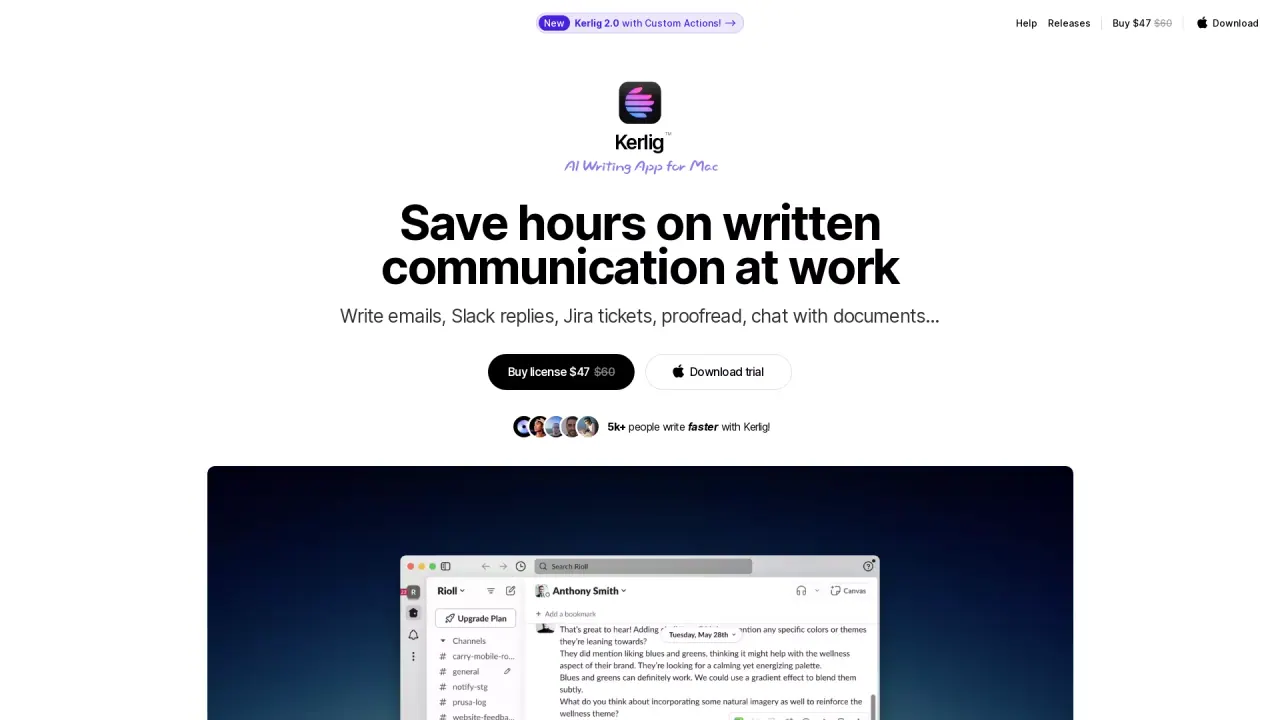
What does Kerlig do?
How does Kerlig work?
Download the Kerlig app for macOS, install it, and define a hotkey. Add at least one AI provider API key or use on-device Apple Foundation Models or local models via Ollama or LM Studio. Then select text in any app, press the hotkey, and choose an action (for example, Fix spelling). Paste the corrected text back into the original app. You can also use built-in actions, customize presets, and run actions across macOS without switching apps.
What platforms and system requirements does Kerlig support?
Kerlig is a macOS app that works on Apple Silicon and Intel Macs, requiring macOS 12+.
What AI models and providers does Kerlig support?
Kerlig supports 350+ models and lets you connect with your preferred AI providers using API keys. It also supports on-device/local options. Model sources include OpenAI, Anthropic, Google, Groq, OpenRouter (with your own API key), plus local options such as Apple Foundation Models, Ollama, and LM Studio.
Do I need an API key or can I use local models?
You can connect with AI providers using API keys, or use on-device Apple Foundation Models, or run local models via Ollama or LM Studio.
What are the major features and capabilities of Kerlig?
- Proofread, fix spelling and grammar, improve writing, summarize, and shorten text
- Chat with documents, analyze and summarize attachments, and chat with web content
- Built-in and custom actions to fit your workflow
- Use your tone of voice and presets for consistent style
- Integrations with AI providers and local models
- Attachments support, citations, and reasoning models for multi-step tasks
- Chat interface, edit messages, regenerate responses
- Shortcuts and global hotkeys for speed
- Headless mode to run actions in the background
- Chat history for easy reference
- Local model support (Apple Foundation Models, Ollama, LM Studio)
How do attachments and documents work in Kerlig?
Attachments can be analyzed, summarized, and chatted about—the app supports the most popular document types for this workflow.
How is privacy and data handling managed in Kerlig?
Your messages are sent directly to AI providers, then stored and encrypted on your Mac.
What is the pricing and licensing structure for Kerlig?
Kerlig uses a one-time payment model (no subscription) with token usage. Pricing shown on the site includes:
- Basic License: $49 (New Year Deal: Lifetime Updates) for 1 Mac (1 seat), includes Vision, Attachments, Presets, Use your tone of voice, 350+ models, Apple Foundation Models, Ollama, LM Studio, and 48h email support.
- Pro License: $79 (New Year Deal: Lifetime Updates) for 2 Macs (2 seats), same inclusions as Basic, and 24h email support.
- Team License: $297 for 10 Macs (10 seats), includes remote team deployment via CLI, Vision, Attachments, Presets, Use your tone of voice, 350+ models with your own API key, plus Apple Foundation Models, Ollama, LM Studio, one year of app updates, and priority Zoom & email support.
Prices are in USD and VAT may apply. There is a 14-day money-back guarantee.
Note: New Year Deal listings show Lifetime Updates for Basic and Pro; Team license outlines one year of app updates.
What are the differences between Basic, Pro, and Team licenses?
- Basic: 1 Mac, 1 seat, lifetime updates (per promo), core features including Vision, Attachments, Presets, tone of voice, 350+ models, and basic support.
- Pro: 2 Macs, 2 seats, lifetime updates (per promo), same feature set as Basic plus faster support.
- Team: 10 Macs, 10 seats, remote team deployment via CLI, includes local and external model support, 350+ models with your API key, plus local models, priority support, and 1 year of app updates.
Is there a refund policy?
Yes. Kerlig offers a 14-day money-back guarantee. Prices shown are in USD and VAT may apply.
What level of support is included with each license?
- Basic: 48-hour email support
- Pro: 24-hour email support
- Team: Priority Zoom and email support
Can Kerlig be deployed for a team via CLI?
Yes. The Team license includes remote team deployment via CLI commands.
Can I use Kerlig with local models, or only cloud providers?
Kerlig supports local models (Apple Foundation Models, Ollama, LM Studio) in addition to cloud providers via API keys.
Where can I find guides for API keys and local models?
Guides are available for obtaining API keys from major providers (OpenAI, Anthropic Claude, Google Gemini, Perplexity, Groq, OpenRouter) and for running local models.
This listing is claimed
Own Kerlig? Sign in with the email used to claim it to manage this listing, or upgrade to Pro for featured-first placement and a newsletter feature.