Kadoa
AI Web Data Extraction API
Extract web data effortlessly in seconds with Kadoa's AI Web Data Extraction API.
- Pricing
- Paid
- Category
- Scheduling
- Listed
- Apr 20, 2023
- Updated
- May 25, 2026
Promoted
 KurodyneSell the tools from your AI side projects. Listing is free.
 Sidrune AI85% off. Stable Claude API for agent developers. Pay as you go. Invoices & refunds available.
 Pixmax.aiPixmax.ai is an all-in-one AI workspace for videos, visual stories, and marketing content.
 RewindType any X/Twitter handle. Get their year back as a narrated video story. Then ask it anything.
 SEOify - Improve your SEO & rankingsBuild links to rank in Google. Improve your DR with links you can start building now.Advertise here270,000+ people visit Dang.ai every month.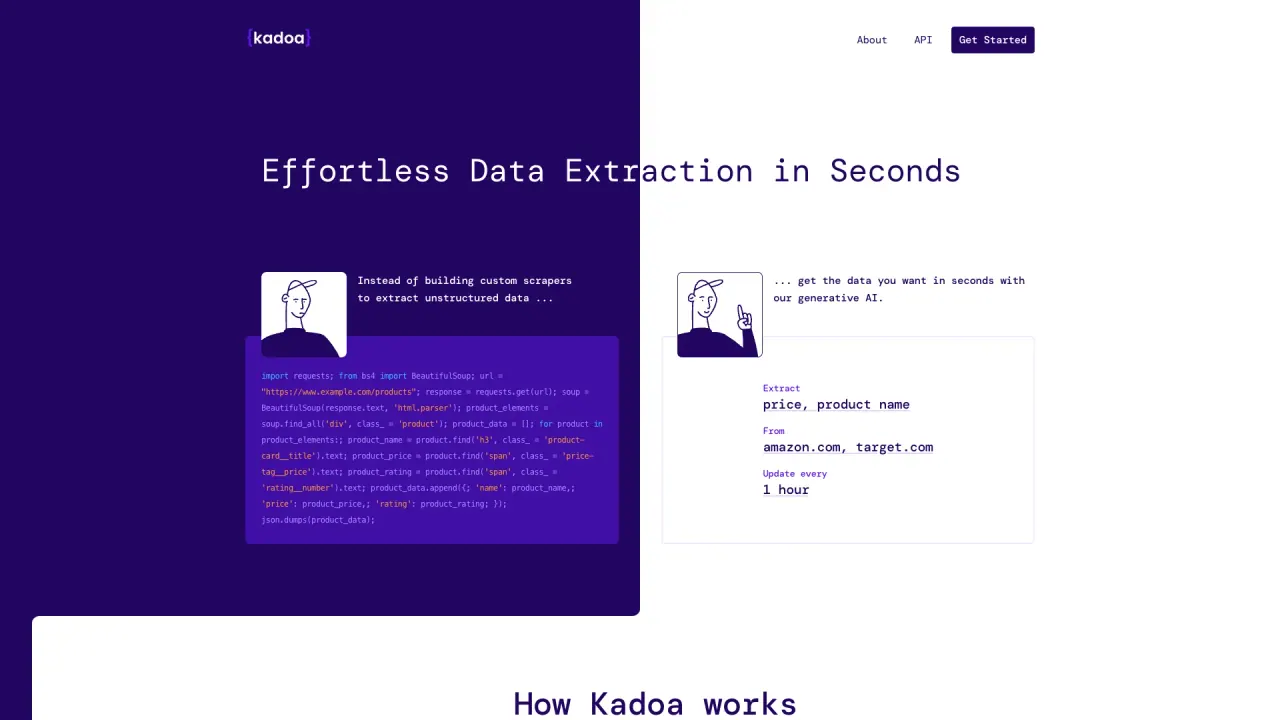
What does Kadoa do?
What are the main use cases and capabilities of Kadoa?
Kadoa is designed to turn public data into reliable datasets quickly, with a focus on finance but applicable across use cases. Key use cases include:
- Financial data research and real-time market monitoring
- Retail intelligence (prices, availability, catalogs)
- ETL for large language models (LLMs) and AI workflows
- Job market data collection from career pages
- Media monitoring and brand tracking
Core capabilities:
- Real-time alerts when sources update or market-moving data changes
- No-code self-service workflow building
- Ability to extract data from any source format (web pages, PDFs, images, Excel)
- Deterministic extraction and transformation logic
- Source grounding for traceability (every value links to its origin)
- Data validation rules to enforce domain standards
- Self-healing workflows that adapt to source changes
- Error handling with human review when automatic recovery isn’t possible
- AI agents that generate and maintain scraping code
- Easy data delivery to S3, Snowflake, spreadsheets, via MCP, or CLI
- Fully auditable, explainable outputs
How does Kadoa automate data discovery and extraction?
Kadoa uses AI-driven automation to locate, navigate, and extract required data from unstructured sources (web pages, PDFs, CSVs, etc.) without manual coding. Key aspects:
- Turnkey no-code setup to design end-to-end workflows
- Deterministic extraction that yields consistent results
- Automatic adaptation to source changes, access restrictions, or site issues
- Source grounding and data validation rules to maintain quality and traceability
- Self-Healing workflows that detect and adjust to evolving sources
- When automatic recovery isn’t possible, errors are surfaced for immediate human resolution
What makes Kadoa API-first for developers?
Kadoa is built to be API-first, enabling developers to configure and manage data workflows directly via API. Highlights:
- Pre-built connectors and webhooks for change notifications
- Easy integration with existing systems without glue code
- Comprehensive API documentation
- Programmable workflow definitions to tailor extractions and transformations
- Ability to push or sync extracted data to external tools and platforms
How does Kadoa ensure data provenance, quality, and auditability?
Kadoa emphasizes traceability and reliability through:
- Source Grounding: Every data value links to its exact source
- Data Validation Rules: Custom checks enforce domain-specific quality
- Self-Healing Workflows: Automatic adaptation to source changes
- Error Handling & Human Review: Immediate notification and human resolution when needed
- Deterministic results: Consistent outputs that are explainable and auditable
What sources and formats can Kadoa handle?
Kadoa supports a wide range of input formats and sources, including:
- Web pages
- PDFs
- Excel files
- Images
- Any source format within a single workflow
This enables extraction from diverse public data sources without bespoke scrapers
How does Kadoa handle changes to sources and maintain reliability?
Kadoa uses Change Detection and Self-Healing Workflows to stay current:
- Automated detection of source updates or structure changes
- Self-Healing behavior that adapts scraping logic to continue functioning
- If automatic recovery isn’t possible, alerts are sent to the team for quick resolution
- Browsers and automation code are designed to emulate human patterns to avoid blocks
How can I deliver and integrate the extracted data?
Kadoa supports flexible data delivery and integration:
- Push data directly to S3, Snowflake, or spreadsheets
- Use the MCP and CLI to connect with internal AI tools and agents
- Webhooks and pre-built connectors simplify downstream workflows
- Integrates with tools you already use for a seamless data stack
What security, privacy, and deployment options does Kadoa offer?
Kadoa provides enterprise-grade security, privacy, and deployment options:
- Security and compliance: SOC 2 certified; encryption at rest and in transit; regular third-party penetration testing
- Access control and auditing: SSO/SAML with automated user provisioning (SCIM); granular, customizable user roles; comprehensive audit logs; strict data isolation in multi-tenant environments
- Data under your control: On-premise or private cloud deployment options; data is never shared between customers; data is never used for AI training; workflows, sources, and schemas remain proprietary and confidential
- Automated compliance: Configurable compliance rules and restrictions; compliance officer approval before data collection; sensitive data detection; automated robots.txt checks; compliance documentation
How quickly can I get a dataset from Kadoa?
From source to dataset in minutes. Kadoa enables you to point at a source, describe the data you need, and have a dataset generated rapidly through a self-service workflow, without waiting on data engineering queues.
What happens if there's an extraction error or a source issue?
Kadoa provides robust error handling and escalation:
- Automated recovery attempts via self-healing workflows
- If recovery isn’t possible, you are notified immediately
- Our team can resolve issues to restore data flow, ensuring minimal disruption to monitoring and decision-making
Why choose Kadoa over traditional web scrapers?
Kadoa offers a modern, reliable alternative to brittle, custom scrapers:
- Deterministic, auditable results with full provenance
- Source-grounded data for fully explainable datasets
- Self-healing workflows that adapt to site changes without breaking
- No-code, self-service workflow design plus API-first integrations
- Real-time alerts and robust integration options
- AI agents that generate and maintain scraping code rather than relying on black-box models
Does Kadoa provide real-time alerts for updates or market-moving data?
Yes. Kadoa supports real-time alerts via Slack, email, or webhooks whenever a source updates or market-moving data changes, helping you act quickly on new information.
Is this your tool?
Claim Kadoa to manage this listing, or upgrade to Pro for featured-first placement and a newsletter feature.